Ch. 12 - Characterizing and Classifying Eukaryotes
Bauman - Microbiology with Diseases by Taxonomy 6th Edition
Bauman6th EditionMicrobiology with Diseases by TaxonomyISBN: 9780134832302Not the one you use?Change textbook
Chapter 12, Problem 5

Tubular filaments with cross walls found in large fungi are ___________.
a. Septate hyphae
b. Aseptate hyphae
c. Aseptate haustoria
d. Dimorphic mycelia

Verified step by step guidance
1
Understand the structure of fungal hyphae: Hyphae are the thread-like filaments that make up the mycelium of a fungus.
Recall that hyphae can be classified based on the presence or absence of cross walls (septa) within the filaments.
Identify that 'septate hyphae' have cross walls (septa) dividing the filament into distinct cells, while 'aseptate hyphae' lack these cross walls and appear as continuous tubes.
Recognize that 'haustoria' are specialized structures used by some parasitic fungi to extract nutrients from host cells, and 'dimorphic mycelia' refers to fungi that can switch between yeast and filamentous forms.
Conclude that the term describing tubular filaments with cross walls in large fungi corresponds to 'septate hyphae'.

Verified video answer for a similar problem:

This video solution was recommended by our tutors as helpful for the problem above.
Video duration:
2m
Was this helpful?

Key Concepts

Here are the essential concepts you must grasp in order to answer the question correctly.

Hyphae Structure in Fungi

Hyphae are the thread-like filaments that make up the mycelium of a fungus. They can be either septate, meaning they have cross walls (septa) dividing the cells, or aseptate, lacking these cross walls and forming a continuous cytoplasmic mass.
Recommended video:

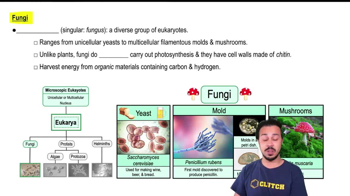
Septate vs. Aseptate Hyphae

Septate hyphae contain septa that separate individual cells, allowing compartmentalization and controlled flow of organelles. Aseptate hyphae lack septa, resulting in a multinucleate, continuous cytoplasm, typical of some lower fungi like Zygomycetes.
Recommended video:
Guided course
05:56
Needham vs. Spallanzani

Fungal Terminology: Haustoria and Dimorphic Mycelia

Haustoria are specialized hyphal structures used by parasitic fungi to extract nutrients from host cells. Dimorphic mycelia refer to fungi that can switch between yeast and filamentous forms depending on environmental conditions, unrelated to the presence of septa.
Recommended video:
Guided course
03:09
Hierarchy of Microbial Growth Control Terminology