Ch. 12 - Characterizing and Classifying Eukaryotes
Bauman - Microbiology with Diseases by Taxonomy 6th Edition
Bauman6th EditionMicrobiology with Diseases by TaxonomyISBN: 9780134832302Not the one you use?Change textbook
Chapter 12, Problem 1

Haploid nuclei ___________.


a. contain one set of chromosomes
b. contain two sets of chromosomes
c. contain half a set of chromosomes
d. are found in the cytosol of eukaryotic organisms

Verified step by step guidance
1
Understand the definition of 'haploid': In biology, 'haploid' refers to a cell or nucleus that contains a single complete set of chromosomes, which is half the number found in diploid cells.
Recall that diploid cells have two sets of chromosomes (one from each parent), so haploid cells have exactly one set, not half a set or two sets.
Recognize that haploid nuclei are typically found in gametes (such as sperm and egg cells) of eukaryotic organisms, and they contain one set of chromosomes.
Evaluate each option based on this knowledge: (a) one set of chromosomes, (b) two sets, (c) half a set, and (d) location in the cytosol (which is incorrect because nuclei are inside the nucleus, not free in the cytosol).
Conclude that the correct understanding is that haploid nuclei contain one set of chromosomes, corresponding to option (a).

Verified video answer for a similar problem:

This video solution was recommended by our tutors as helpful for the problem above.
Video duration:
1m
Was this helpful?

Key Concepts

Here are the essential concepts you must grasp in order to answer the question correctly.

Haploid Nuclei

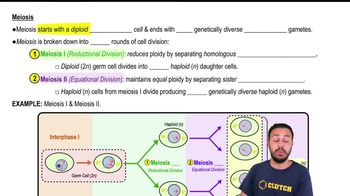
Haploid nuclei contain a single set of chromosomes, meaning they have one copy of each chromosome. This is typical of gametes (sperm and egg cells) in sexually reproducing organisms, allowing chromosome number to be restored upon fertilization.
Recommended video:

Chromosome Sets in Cells

Cells can be haploid or diploid based on chromosome number. Diploid cells have two sets of chromosomes (one from each parent), while haploid cells have only one set. This distinction is crucial for understanding genetic inheritance and cell division.
Recommended video:
Guided course
09:41
Hfr Cell Conjugation

Location of Nuclei in Eukaryotic Cells

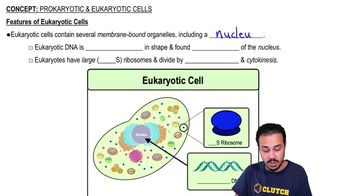
In eukaryotic cells, nuclei are membrane-bound organelles located within the cytoplasm, not free-floating in the cytosol. The nucleus houses genetic material and controls cellular activities, distinguishing it from prokaryotic cells.
Recommended video:
Guided course
04:17
Features of Eukaryotic Cells