Ch. 11 - Characterizing and Classifying Prokaryotes
Bauman - Microbiology with Diseases by Taxonomy 6th Edition
Bauman6th EditionMicrobiology with Diseases by TaxonomyISBN: 9780134832302Not the one you use?Change textbook
Chapter 11, Problem 7

For each of the following statements that is true, write “true” in the blank. For each statement that is false, write the word(s) that should be substituted for the underlined word(s) to make the statement correct.
__________ Pigments located in thylakoids in phototrophic bacteria trap light energy for metabolic processes.

Verified step by step guidance
1
Identify the type of pigments involved in phototrophic bacteria that are responsible for trapping light energy. These pigments are typically involved in photosynthesis or similar light-dependent metabolic processes.
Recall that in phototrophic bacteria, the pigments that trap light energy are called 'bacteriochlorophylls' or 'chlorophylls', depending on the bacterial type, rather than just 'pigments' in general.
Understand that these pigments are located in specialized membrane structures called 'thylakoids' or 'chromatophores' within the bacteria, which serve as the site for light absorption.
Evaluate the statement to see if the underlined word 'Pigments' is accurate or if it should be replaced with a more specific term such as 'Bacteriochlorophylls' to correctly describe the light-trapping molecules.
Conclude whether the statement is true as is or if the word 'Pigments' should be substituted with 'Bacteriochlorophylls' (or the appropriate pigment name) to make the statement scientifically accurate.

Verified video answer for a similar problem:

This video solution was recommended by our tutors as helpful for the problem above.
Video duration:
1m
Was this helpful?

Key Concepts

Here are the essential concepts you must grasp in order to answer the question correctly.

Phototrophic Bacteria

Phototrophic bacteria are microorganisms that capture light energy to drive their metabolic activities, often through photosynthesis or related processes. Unlike plants, some use bacteriochlorophylls and other pigments to absorb light, enabling them to produce energy in diverse environments.
Recommended video:
Guided course
07:37
Prototrophs vs. Auxotrophs

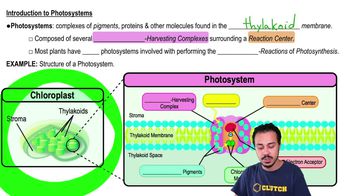
Thylakoids

Thylakoids are membrane-bound structures found in chloroplasts of plants and in some phototrophic bacteria. They house pigments and proteins essential for capturing light energy and converting it into chemical energy during photosynthesis or phototrophic metabolism.
Recommended video:
Guided course
04:59
Introduction to Photosystems

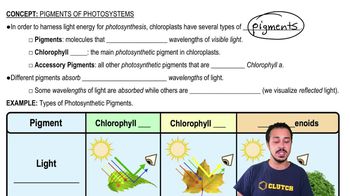
Light-Harvesting Pigments

Light-harvesting pigments, such as chlorophylls and bacteriochlorophylls, absorb specific wavelengths of light to initiate energy conversion processes. In phototrophic bacteria, these pigments are embedded in thylakoid membranes and are crucial for trapping light energy for metabolic use.
Recommended video:
Guided course
05:58
Pigments of Photosynthesis