Ch. 10 - Controlling Microbial Growth in the Body: Antimicrobial Drugs
Bauman - Microbiology with Diseases by Taxonomy 6th Edition
Bauman6th EditionMicrobiology with Diseases by TaxonomyISBN: 9780134832302Not the one you use?Change textbook
Chapter 10, Problem 3

Why is the fact that drug Z destroys the NAM portions of a cell’s wall structure an important factor in considering the drug for chemotherapy?

Verified step by step guidance
1
Step 1: Understand the structure of bacterial cell walls, focusing on peptidoglycan, which is composed of alternating units of N-acetylglucosamine (NAG) and N-acetylmuramic acid (NAM). NAM is a critical component that provides structural integrity to the cell wall.
Step 2: Recognize that many antibiotics target the bacterial cell wall because it is essential for bacterial survival and is absent in human cells, making it an ideal selective target for chemotherapy.
Step 3: Analyze how drug Z's destruction of the NAM portions disrupts the peptidoglycan layer, weakening the cell wall and leading to bacterial cell lysis due to osmotic pressure.
Step 4: Consider that targeting NAM specifically can be highly effective because it interferes with the synthesis or stability of the cell wall, which is vital for bacterial growth and maintenance.
Step 5: Conclude that drug Z's mechanism of action makes it a promising candidate for chemotherapy as it selectively attacks a bacterial-specific structure, minimizing harm to human cells and effectively killing bacteria.

Verified video answer for a similar problem:

This video solution was recommended by our tutors as helpful for the problem above.
Video duration:
2m
Was this helpful?

Key Concepts

Here are the essential concepts you must grasp in order to answer the question correctly.

Structure and Function of Peptidoglycan in Bacterial Cell Walls

Peptidoglycan is a critical component of bacterial cell walls, providing structural strength and shape. It consists of sugar chains, including N-acetylmuramic acid (NAM), cross-linked by peptides. Disrupting NAM weakens the cell wall, leading to bacterial lysis, making it a prime target for antibiotics.
Recommended video:
Guided course
03:44
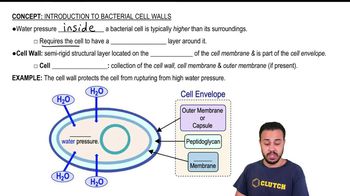
Introduction to Bacterial Cell Walls

Mechanism of Action of Cell Wall-Targeting Antibiotics

Antibiotics that target cell wall synthesis, such as those affecting NAM, inhibit the formation or integrity of peptidoglycan. This prevents bacteria from maintaining their cell wall, causing osmotic imbalance and cell death. Understanding this mechanism is essential for evaluating drug Z’s effectiveness.
Recommended video:
Guided course
03:44
Introduction to Bacterial Cell Walls

Selective Toxicity in Chemotherapy

Selective toxicity refers to a drug’s ability to target microbial cells without harming host cells. Since human cells lack peptidoglycan and NAM, drugs that destroy NAM selectively kill bacteria, making them suitable for chemotherapy with minimal side effects on human tissues.
Recommended video:
Guided course
03:27
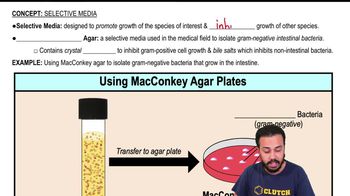
Selective Media
Related Practice
Textbook Question

What specific test for antimicrobial efficacy is shown? What does this test measure? Draw an oval to predict the size and shape of the zone of inhibition if the drug concentration on the strip were increased twofold.

<IMAGE>

3
views
Textbook Question

In a Kirby-Bauer susceptibility test, the presence of a zone of inhibition around disks containing antimicrobial agents indicates __________ .

a. That the microbe does not grow in the presence of the agents

b. That the microbe grows well in the presence of the agents

c. The smallest amount of the agent that will inhibit the growth of the microbe

d. The minimum amount of an agent that kills the microbe in question

5
views
Textbook Question

Given that both human cells and pathogens synthesize proteins at ribosomal sites, how can antimicrobial agents that target this process be safe to use in humans?

Textbook Question

Which of the following statements is relevant in explaining why sulfonamides are effective?

a. Sulfonamides attach to sterol lipids in the pathogen, disrupt the membranes, and lyse the cells.

b. Sulfonamides prevent the incorporation of amino acids into polypeptide chains.

c. Humans and microbes use PABA differently in their metabolism.

d. Sulfonamides inhibit DNA replication in both pathogens and human cells.

4
views
Textbook Question

Contrast narrow-spectrum and broad-spectrum drugs. Which are more effective?

Textbook Question

The key to successful chemotherapy is __________ .

a. Selective toxicity

b. A diffusion test

c. The minimum inhibitory concentration test

d. The spectrum of action