Ch. 10 - Controlling Microbial Growth in the Body: Antimicrobial Drugs
Bauman - Microbiology with Diseases by Taxonomy 6th Edition
Bauman6th EditionMicrobiology with Diseases by TaxonomyISBN: 9780134832302Not the one you use?Change textbook
Chapter 10, Problem 1

Label each of the accompanying figures to indicate the class of drug that is stopping polypeptide translation.


<IMAGE> <IMAGE>
a. ________________ b. _________________
block initiation. change 30S subunit.


<IMAGE> <IMAGE>
c. ________________ d. _________________
block ribosome attachment inhibits peptide bonding


<IMAGE> <IMAGE>
e. ________________ g. _________________
f. ________________ h. _________________
block ribosome movement block tRNA docking

Verified step by step guidance
1
Step 1: Understand the mechanism of polypeptide translation and how different classes of antibiotics interfere with this process. Translation involves initiation, elongation (including tRNA docking and peptide bond formation), and termination stages.
Step 2: For figures labeled a and b, identify drugs that block initiation by altering the 30S ribosomal subunit. These are typically aminoglycosides or tetracyclines that bind to the 30S subunit and prevent the formation of the initiation complex.
Step 3: For figures c and d, focus on drugs that block ribosome attachment or inhibit peptide bond formation. These often include chloramphenicol (which inhibits peptidyl transferase activity) or macrolides (which block the exit tunnel or ribosome movement).
Step 4: For figures e, f, g, and h, determine which drugs block ribosome movement along mRNA or block tRNA docking. For example, fusidic acid blocks ribosome translocation, while tetracyclines block tRNA docking to the A site on the ribosome.
Step 5: Match each figure to the corresponding drug class based on the described mechanism: initiation block (30S subunit alteration), ribosome attachment/peptide bond inhibition, ribosome movement block, and tRNA docking block. Use knowledge of antibiotic classes and their targets on the ribosome to label each figure correctly.

Verified video answer for a similar problem:

This video solution was recommended by our tutors as helpful for the problem above.
Video duration:
2m
Was this helpful?

Key Concepts

Here are the essential concepts you must grasp in order to answer the question correctly.

Mechanism of Action of Antibiotics Targeting Translation

Many antibiotics inhibit bacterial protein synthesis by targeting specific steps in translation, such as initiation, elongation, or termination. They often bind to ribosomal subunits (30S or 50S), blocking functions like tRNA docking, peptide bond formation, or ribosome movement, thereby halting polypeptide chain elongation.
Recommended video:
Guided course
06:12
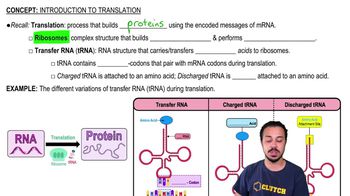
Introduction to Translation

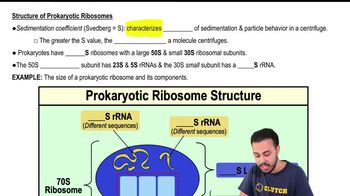
Structure and Function of Ribosomal Subunits

Bacterial ribosomes consist of two subunits: 30S (small) and 50S (large). The 30S subunit is involved in mRNA decoding and initiation, while the 50S subunit catalyzes peptide bond formation. Understanding which subunit a drug targets helps explain its inhibitory effect on translation.
Recommended video:
Guided course
08:39
Structure of Prokaryotic Ribosomes

Stages of Translation and Points of Inhibition

Translation proceeds through initiation, elongation, and termination. Antibiotics can block initiation by preventing ribosome assembly, inhibit elongation by blocking tRNA binding or peptide bond formation, or stop ribosome translocation along mRNA. Identifying the inhibited stage clarifies the drug’s mode of action.
Recommended video:
Guided course
05:03
Enzyme Inhibition