
Textbook Question
Which of the following microorganisms are not eukaryotic?
a) Bacteria
b) Yeasts
c) Molds
d) Protozoa
 Verified step by step guidance
 05:59
05:59
 06:29
06:29 06:58
06:58Which of the following microorganisms are not eukaryotic?
a) Bacteria
b) Yeasts
c) Molds
d) Protozoa
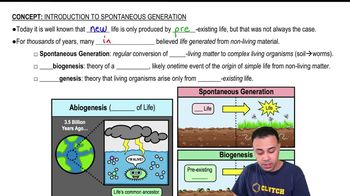
Show where microbes ended up in Pasteur’s experiment.
Fill in the blanks with the name(s) of the scientist(s) whose investigations led to the following fields of study in microbiology.
Biochemistry _________ and __________.
On the following photos, label cilium, flagellum, nucleus, and pseudopod.
<IMAGE>
Match each of the following descriptions with the person it best describes more than once or not at all. An answer may be used more than once.
1. Developed smallpox immunization
2. First photomicrograph of bacteria
3. Used mathematical data to improve nursing
4. Germs cause disease
5. Sought a “magic bullet” to destroy pathogens
6. Early epidemiologist
7. Father of Microbiology
8. Classification system
9. Discoverer of bacteria
10. Discoverer of protozoa
11. Founder of antiseptic surgery
12. Developed the most widely used bacterial staining technique
A. John Snow
B. Paul Ehrlich
C. Louis Pasteur
D. Antoni van Leeuwenhoek
E. Carolus Linnaeus
F. John Needham
G. Eduard Buchner
H. Robert Koch
I. Joseph Lister
J. Edward Jenner
K. Girolamo Fracastoro
L. Hans Christian Gram
M. Florence Nightingale
Which microorganisms are used to make microbiological growth media?
a. Bacteria
b. Fungi
c. Algae
d. Protozoa