Back

Types of Acquired Immunity quiz

Control buttons has been changed to "navigation" mode.
1/15
  • What is naturally acquired immunity?

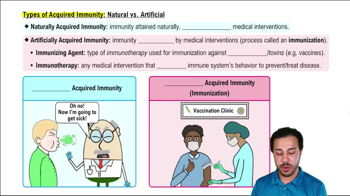
    Naturally acquired immunity is when immunity is attained without deliberate medical or laboratory interventions, such as recovering from an infection.
  • How is artificially acquired immunity induced?

    Artificially acquired immunity is induced deliberately by medical or laboratory interventions, like vaccines or antibody infusions.
  • What is the process of inducing artificial immunity called?

    The process of inducing artificial immunity is called immunization.
  • What are immunizing agents?

    Immunizing agents are types of immunotherapy used for immunization against specific pathogens or toxins, such as vaccines and monoclonal antibodies.
  • What does immunotherapy refer to?

    Immunotherapy refers to any medical intervention that alters the immune system’s behavior to control, prevent, or treat disease.
  • What is actively acquired immunity?

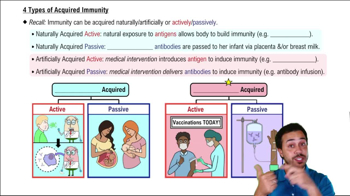
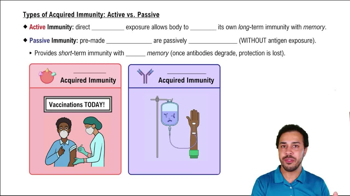
    Actively acquired immunity is when direct antigen exposure allows the body to build its own long-term immunity with a memory component.
  • How does active immunity train the immune system?

    Active immunity trains the immune system to build its own supply of T cells, B cells, and antibodies.
  • What is passively acquired immunity?

    Passively acquired immunity is when premade immune components, usually antibodies, are delivered to a recipient without antigen exposure.
  • Why does passive immunity provide only short-term protection?

    Passive immunity provides short-term protection because the delivered antibodies degrade over time and the immune system is not trained to produce its own.
  • What is an example of naturally acquired active immunity?

    An example is recovering from an infection after natural exposure to antigens, such as someone sneezing and you getting sick.
  • How is naturally acquired passive immunity obtained?

    It is obtained when a mother's antibodies are passively delivered to her infant via the placenta or breast milk.
  • What distinguishes naturally acquired passive immunity from active immunity?

    Naturally acquired passive immunity involves receiving premade antibodies without antigen exposure, while active immunity involves direct antigen exposure.
  • What is an example of artificially acquired active immunity?

    An example is receiving a vaccine, which introduces antigens to induce immunity.
  • How is artificially acquired passive immunity achieved?

    It is achieved by medical intervention delivering premade antibodies, such as through antibody infusions.
  • Why does artificially acquired passive immunity not provide long-term protection?

    Because the recipient's immune system is not trained and protection is lost once the delivered antibodies degrade.