What type of antibody mediates Type I hypersensitivities?
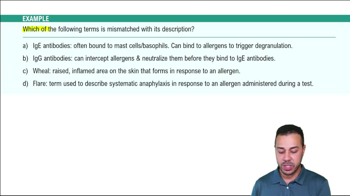
Type I hypersensitivities are mediated by IgE antibodies.
How quickly do Type I hypersensitivity reactions typically occur after allergen exposure?
They usually occur within about thirty minutes of exposure.
What is an allergen?
An allergen is an exogenous antigen that originates outside the human body and triggers hypersensitivity reactions.
What cells are sensitized during the initial exposure to an allergen in Type I hypersensitivity?
Mast cells and basophils are sensitized by IgE antibodies during the initial exposure.
What happens to mast cells and basophils upon re-exposure to the allergen?
They degranulate, releasing pro-inflammatory mediators like histamine.
What is the main pro-inflammatory mediator released during Type I hypersensitivity reactions?
Histamine is the main pro-inflammatory mediator released.
What is the difference between localized allergic reactions and systemic anaphylaxis?
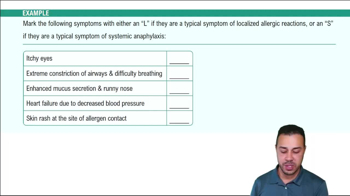
Localized reactions are confined to the exposure site or a single organ system, while systemic anaphylaxis affects multiple organ systems and can be life-threatening.
What is anaphylactic shock?
Anaphylactic shock is dangerously low systemic blood pressure caused by widespread blood vessel dilation and leakage, leading to organ failure or suffocation.
Name two common allergens that can cause systemic anaphylaxis.
Common allergens include insect venom (bee or wasp stings) and foods like peanuts and shellfish.
What medication is commonly used to treat systemic anaphylaxis?
Epinephrine, often administered via an EpiPen, is used to treat systemic anaphylaxis.
How does epinephrine help during anaphylaxis?
Epinephrine constricts blood vessels, prevents leakage, and helps unblock airways to reverse life-threatening effects.
What test is commonly used to diagnose allergies?
The Prick Puncture Skin Test (PPST) is commonly used to diagnose allergies.
What indicates a positive result in the Prick Puncture Skin Test?
A wheal and flare reaction, with a raised inflamed area and surrounding redness, indicates a positive result.
What is the goal of immunotherapy desensitization for allergies?
The goal is to reduce the severity of the allergic response, often by promoting IgG antibody production.
How do IgG antibodies help in desensitization therapy?
IgG antibodies bind to the allergen before IgE antibodies can, reducing the severity of the allergic response.
 Back
Back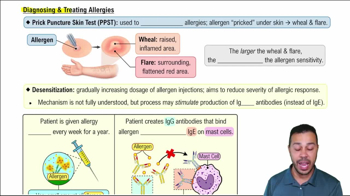
 04:31
04:31