Skip to main content
Microbiology
My Course
Learn
Exam Prep
AI Tutor
Study Guides
Textbook Solutions
Flashcards
Explore
Try the app
My Course
Learn
Exam Prep
AI Tutor
Study Guides
Textbook Solutions
Flashcards
Explore
Try the app
Back
Stages of Photosynthesis definitions
You can tap to flip the card.
Photosynthesis
You can tap to flip the card.
👆
Photosynthesis
A two-stage process in cells that transforms solar energy, water, and carbon dioxide into glucose and oxygen.
Track progress
Control buttons has been changed to "navigation" mode.
1/15
Related flashcards
Related practice
Recommended videos
Stages of Photosynthesis quiz
Stages of Photosynthesis
15 Terms
Stages of Photosynthesis
13. Photosynthesis
3 problems
Topic
Nicole
Light Reactions of Photosynthesis
13. Photosynthesis
1 problem
Topic
Monica
13. Photosynthesis
9 topics
13 problems
Chapter
Nicole
03:16
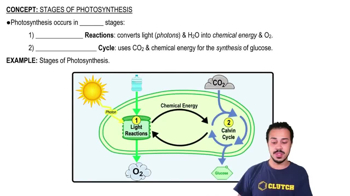
Stages of Photosynthesis
7
views
02:40
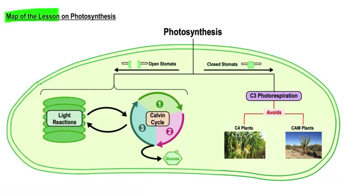
Map of the Lesson on Photosynthesis
4
views
Terms in this set (15)
Hide definitions
Photosynthesis
A two-stage process in cells that transforms solar energy, water, and carbon dioxide into glucose and oxygen.
Light Reactions
The initial stage that uses photons and water to generate chemical energy and oxygen within thylakoids.
Calvin Cycle
A sequence using carbon dioxide and chemical energy to synthesize glucose, occurring in the stroma.
Chloroplast
A eukaryotic organelle serving as the main site for both stages of photosynthesis.
Thylakoid
A membrane-bound structure inside chloroplasts where the light reactions take place.
Stroma
The fluid-filled region of the chloroplast where the Calvin cycle occurs.
Prokaryote
A cell type lacking chloroplasts, conducting photosynthesis in the plasma membrane and cytoplasm.
Eukaryote
A cell type containing chloroplasts, where photosynthesis is compartmentalized into specialized organelles.
Plasma Membrane
The cellular boundary in prokaryotes where light reactions of photosynthesis are localized.
Cytoplasm
The internal cell matrix in prokaryotes where the Calvin cycle is carried out.
Oxygen
A gaseous product released during the light reactions of photosynthesis.
Glucose
A carbohydrate synthesized during the Calvin cycle, serving as an energy source for cells.
Chemical Energy
The energy-rich molecules produced in the light reactions, fueling the Calvin cycle.
Carbon Dioxide
A gaseous input from the atmosphere, fixed into organic molecules during the Calvin cycle.
Solar Energy
The energy from sunlight harnessed during the light reactions to drive photosynthetic processes.
 BackBack
 03:16
03:16