Back

Reviewing the Types of Culture Media definitions

Control buttons has been changed to "navigation" mode.
1/13
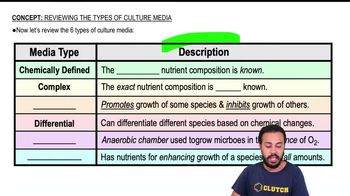
  • Chemically Defined Media

    A growth medium with a precisely known nutrient composition, allowing for controlled studies of microbial requirements.
  • Chemically Complex Media

    A nutrient-rich medium with an unknown exact composition, supporting diverse microbial growth due to its complexity.
  • Selective Media

    A medium formulated to encourage the growth of certain microbes while suppressing others, often using specific inhibitors.
  • McConkey Agar

    A classic example of a selective medium, commonly used to isolate and differentiate Gram-negative bacteria.
  • Differential Media

    A medium that distinguishes microbial species visually based on observable chemical changes, such as color shifts.
  • Blood Agar

    A differential medium used to identify hemolytic patterns of bacteria, such as beta and alpha hemolysis.
  • Reducing Media

    A medium containing reducing agents, facilitating the growth of anaerobes by eliminating oxygen.
  • Reducing Agents

    Substances in media that remove oxygen, creating an environment suitable for anaerobic organisms.
  • Anaerobic Chamber

    An oxygen-free environment used with specific media to cultivate microbes intolerant to oxygen.
  • Enrichment Media

    A medium designed to enhance the growth of a particular microbe present in low numbers, without using inhibitors.
  • Nutrient Composition

    The specific combination and amounts of nutrients present in a culture medium, influencing microbial growth.
  • Beta Hemolysis

    A clear zone around colonies on blood agar, indicating complete lysis of red blood cells by bacteria.
  • Alpha Hemolysis

    A greenish discoloration around colonies on blood agar, signifying partial lysis of red blood cells.