Back

Review of Transcription vs. Translation definitions

Control buttons has been changed to "navigation" mode.
1/15
  • Transcription

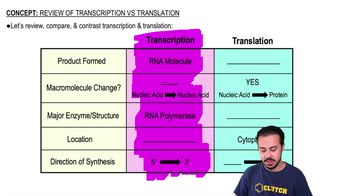
    Process in which DNA serves as a template to synthesize an RNA molecule, occurring in the nucleus of eukaryotic cells.
  • Translation

    Process where an RNA molecule is used as a template to assemble a protein, taking place in the cytoplasm.
  • DNA

    Nucleic acid that stores genetic information and acts as the template for RNA synthesis during transcription.
  • RNA

    Nucleic acid produced from a DNA template, serving as the intermediary between DNA and protein synthesis.
  • Protein

    Macromolecule composed of amino acids, synthesized from an RNA template during translation.
  • RNA Polymerase

    Enzyme responsible for synthesizing RNA from a DNA template during transcription.
  • Ribosome

    Cellular structure that facilitates the assembly of amino acids into proteins using an RNA template.
  • Nucleus

    Membrane-bound compartment in eukaryotic cells where transcription occurs.
  • Cytoplasm

    Cellular region outside the nucleus where translation and protein synthesis take place.
  • Nucleic Acid

    Class of macromolecules including DNA and RNA, involved in storing and transmitting genetic information.
  • Amino Acid

    Building block of proteins, linked together during translation to form polypeptides.
  • Macromolecule

    Large biological molecule, such as nucleic acids or proteins, essential for cellular structure and function.
  • 5' to 3' Direction

    Orientation in which RNA is synthesized during transcription, starting from the 5' end toward the 3' end.
  • N-terminal

    Amino end of a protein, marking the starting point for protein synthesis during translation.
  • C-terminal

    Carboxyl end of a protein, representing the endpoint of protein synthesis during translation.