Back

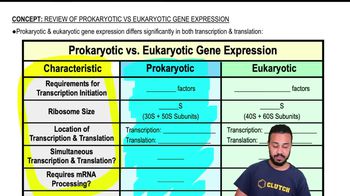
Review of Prokaryotic vs. Eukaryotic Gene Expression definitions

Control buttons has been changed to "navigation" mode.
1/15
  • Sigma Factor

    Protein required for RNA polymerase binding and transcription initiation in prokaryotes.
  • Transcription Factor

    Protein complex necessary for RNA polymerase binding and transcription initiation in eukaryotes.
  • 70S Ribosome

    Prokaryotic ribosome composed of 30S and 50S subunits, essential for protein synthesis.
  • 80S Ribosome

    Eukaryotic ribosome made of 40S and 60S subunits, larger than its prokaryotic counterpart.
  • Nucleoid

    Region in prokaryotes where DNA is located and transcription occurs, lacking a membrane.
  • Nucleus

    Membrane-bound organelle in eukaryotes where DNA is stored and transcription takes place.
  • Cytoplasm

    Cellular compartment where translation occurs in both cell types and transcription in prokaryotes.
  • Rough Endoplasmic Reticulum

    Eukaryotic organelle where translation can occur, characterized by ribosome-studded membranes.
  • mRNA Processing

    Eukaryotic modification of messenger RNA, including capping, polyadenylation, and splicing.
  • 5' Guanine Cap

    Modified nucleotide added to the 5' end of eukaryotic mRNA for stability and translation initiation.
  • Poly-A Tail

    String of adenine nucleotides added to the 3' end of eukaryotic mRNA, enhancing stability.
  • Intron

    Non-coding sequence within eukaryotic genes removed during mRNA processing.
  • Exon

    Coding sequence in eukaryotic genes retained in mature mRNA after splicing.
  • Polycistronic mRNA

    Single prokaryotic mRNA molecule encoding multiple proteins from different genes.
  • Monocistronic mRNA

    mRNA molecule that encodes only one protein, typical in eukaryotes.