Skip to main content
Microbiology
My Course
Learn
Exam Prep
AI Tutor
Study Guides
Textbook Solutions
Flashcards
Explore
Try the app
My Course
Learn
Exam Prep
AI Tutor
Study Guides
Textbook Solutions
Flashcards
Explore
Try the app
Back
Properties of Water- The Universal Solvent quiz
You can tap to flip the card.
Why is water referred to as the universal solvent?
You can tap to flip the card.
👆
Why is water referred to as the universal solvent?
Water is called the universal solvent because it can dissolve many different types of solutes, especially biological molecules.
Track progress
Control buttons has been changed to "navigation" mode.
1/15
Related flashcards
Related practice
Recommended videos
Properties of Water- The Universal Solvent definitions
Properties of Water- The Universal Solvent
15 Terms
Properties of Water- The Universal Solvent
4. Water
4 problems
Topic
Nicole
Acids and Bases
4. Water
4 problems
Topic
Brendan
4. Water
7 topics
14 problems
Chapter
Nicole
06:20
Properties of Water- The Universal Solvent
22
views
04:33
Hydrophilic vs. Hydrophobic
12
views
02:18
Homogenous vs. Heterogenous Solutions
135
views
Terms in this set (15)
Hide definitions
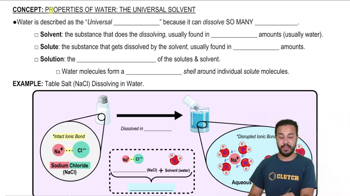
Why is water referred to as the universal solvent?
Water is called the universal solvent because it can dissolve many different types of solutes, especially biological molecules.
What is the definition of a solvent?
A solvent is the substance that does the dissolving and is usually found in larger amounts in a solution.
What is a solute in a solution?
A solute is the substance that gets dissolved by the solvent and is usually present in smaller amounts.
In the example of table salt dissolved in water, which is the solvent and which is the solute?
Water is the solvent, and sodium chloride (table salt) is the solute.
What happens to the ionic bonds of sodium chloride when it is dissolved in water?
The ionic bonds are disrupted because water molecules surround the ions, preventing them from forming ionic bonds.
What is a solution?
A solution is the combination of a solute and a solvent mixed together.
What is an aqueous solution?
An aqueous solution is a solution in which water acts as the solvent.
What is a hydration shell?
A hydration shell is formed when water molecules surround and interact with dissolved solute molecules.
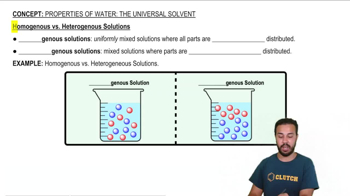
What is the difference between homogeneous and heterogeneous solutions?
Homogeneous solutions are evenly mixed, while heterogeneous solutions have unevenly distributed parts.
What does the prefix 'homo' in homogeneous mean?
'Homo' means the same, indicating uniform distribution in the solution.
What does the prefix 'hetero' in heterogeneous mean?
'Hetero' means different, indicating uneven distribution in the solution.
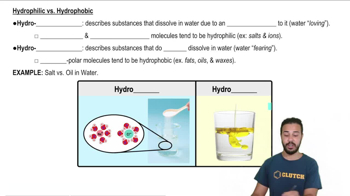
What are hydrophilic substances?
Hydrophilic substances dissolve easily in water because they are water-loving and often polar or charged.
What are hydrophobic substances?
Hydrophobic substances do not dissolve in water; they are water-fearing and usually nonpolar, like fats and oils.
Why do salts and ions dissolve well in water?
Salts and ions are charged and polar, making them hydrophilic and able to interact well with water.
Why does oil not mix well with water?
Oil is hydrophobic and nonpolar, so it does not dissolve or mix well with water.
 BackBack
 06:20
06:20