Skip to main content
Microbiology
My Course
Learn
Exam Prep
AI Tutor
Study Guides
Textbook Solutions
Flashcards
Explore
Try the app
My Course
Learn
Exam Prep
AI Tutor
Study Guides
Textbook Solutions
Flashcards
Explore
Try the app
Back
Properties of Water- Density quiz
You can tap to flip the card.
Why is liquid water more dense than solid ice?
You can tap to flip the card.
👆
Why is liquid water more dense than solid ice?
Liquid water molecules are tightly packed and constantly form and break hydrogen bonds, resulting in higher density compared to solid ice.
Track progress
Control buttons has been changed to "navigation" mode.
1/15
Related flashcards
Related practice
Recommended videos
Properties of Water- Density definitions
Properties of Water- Density
13 Terms
Properties of Water- Density
4. Water
3 problems
Topic
Monica
Properties of Water- Thermal
4. Water
3 problems
Topic
Nicole
4. Water
7 topics
14 problems
Chapter
Nicole
Guided course
04:10
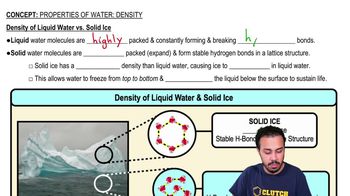
Properties of Water- Density
13
views
Guided course
02:13
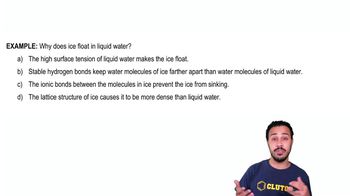
Properties of Water- Density Example 1
17
views
Terms in this set (15)
Hide definitions
Why is liquid water more dense than solid ice?
Liquid water molecules are tightly packed and constantly form and break hydrogen bonds, resulting in higher density compared to solid ice.
What structure do water molecules form in solid ice?
In solid ice, water molecules form stable hydrogen bonds in a lattice structure.
How does the lattice structure of ice affect its density?
The lattice structure causes water molecules in ice to be less packed, making ice less dense than liquid water.
Why does ice float on liquid water?
Ice floats because it is less dense than liquid water due to its expanded lattice structure.
What is the significance of ice floating for life on Earth?
Floating ice insulates the water below, preventing it from freezing solid and allowing life to survive in cold conditions.
How does water freeze in natural environments?
Water freezes from the top down, forming an insulating layer of ice on the surface.
What role does the insulating ice layer play during extreme cold conditions?
The ice layer protects the liquid water beneath, enabling aquatic life to survive during extreme cold, such as ice ages.
What happens to hydrogen bonds in liquid water?
Hydrogen bonds in liquid water are constantly breaking and reforming.
How are hydrogen bonds different in solid ice compared to liquid water?
In solid ice, hydrogen bonds are stable and form a lattice, while in liquid water they are constantly breaking and reforming.
Why is the density difference between liquid water and solid ice important?
The density difference allows ice to float and insulate liquid water, which is crucial for sustaining life.
What would happen if ice were denser than liquid water?
If ice were denser, it would sink, causing bodies of water to freeze solid and threatening aquatic life.
How does the packing of water molecules differ between liquid water and ice?
Liquid water molecules are tightly packed, while ice molecules are less packed due to the lattice structure.
What is the effect of stable hydrogen bonds in ice?
Stable hydrogen bonds in ice create a lattice structure that expands the molecules and lowers density.
How did the properties of water help life survive during ice ages?
The insulating ice layer kept liquid water beneath from freezing solid, allowing life to persist during ice ages.
What will be further explored in the course regarding water’s density?
The importance and implications of density differences between liquid water and solid ice will be further explored.
 BackBack
 04:10
04:10