Skip to main content
Microbiology
My Course
Learn
Exam Prep
AI Tutor
Study Guides
Textbook Solutions
Flashcards
Explore
Try the app
My Course
Learn
Exam Prep
AI Tutor
Study Guides
Textbook Solutions
Flashcards
Explore
Try the app
Back
Properties of Water- Cohesion and Adhesion definitions
You can tap to flip the card.
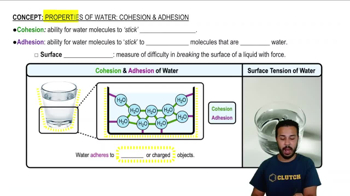
Cohesion
You can tap to flip the card.
👆
Cohesion
Ability of molecules to stick to each other, resulting from hydrogen bonds, crucial for maintaining liquid structure.
Track progress
Control buttons has been changed to "navigation" mode.
1/12
Related flashcards
Related practice
Recommended videos
Properties of Water- Cohesion and Adhesion quiz
Properties of Water- Cohesion and Adhesion
15 Terms
Properties of Water- Cohesion and Adhesion
4. Water
3 problems
Topic
Monica
Properties of Water- Density
4. Water
3 problems
Topic
Monica
4. Water
7 topics
14 problems
Chapter
Nicole
01:46
Properties of Water- Cohesion and Adhesion Example 1
22
views
04:16
Properties of Water- Cohesion and Adhesion
33
views
Terms in this set (12)
Hide definitions
Cohesion
Ability of molecules to stick to each other, resulting from hydrogen bonds, crucial for maintaining liquid structure.
Adhesion
Tendency of molecules to attach to different substances, especially polar or charged surfaces, due to hydrogen bonding.
Hydrogen Bonding
Attractive interaction between a hydrogen atom and an electronegative atom, responsible for unique molecular behaviors.
Surface Tension
Resistance of a liquid's surface to external force, caused by cohesive forces among surface molecules.
Polar Object
Substance with uneven charge distribution, enabling strong interactions with water molecules.
Solvent
Medium capable of dissolving other substances, facilitating biological reactions and transport.
Water Molecule
Compound consisting of two hydrogen atoms and one oxygen atom, exhibiting polarity and hydrogen bonding.
Glass
Polar material that interacts with water through adhesion, often used to demonstrate water's adhesive properties.
Liquid Water
State of H2O where molecules are closely associated, allowing for cohesion, adhesion, and high surface tension.
Charged Surface
Area with net electrical charge, attracting polar molecules like water through adhesive interactions.
Biological Process
Series of chemical events in living organisms, often dependent on water's solvent and cohesive properties.
Paper Clip
Object used to illustrate surface tension, remaining atop water due to cohesive forces at the liquid's surface.
 BackBack
 01:46
01:46