Back

Physical Barriers in First-Line Defenses: Mucous Membrane quiz

Control buttons has been changed to "navigation" mode.
1/15
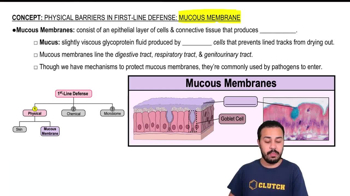
  • What is the main function of mucus membranes in the body?

    Mucus membranes act as physical barriers that protect various tracts of the body and prevent them from drying out.
  • Which cells are responsible for producing mucus in mucus membranes?

    Goblet cells are responsible for producing the mucus found in mucus membranes.
  • What is mucus composed of, and what is its texture?

    Mucus is a slightly viscous glycoprotein fluid.
  • Name three body tracts lined by mucus membranes.

    The digestive, respiratory, and genitourinary tracts are lined by mucus membranes.
  • How does mucus help protect the body from microbes?

    Mucus traps microbes, which can then be expelled from the body, helping to prevent infection.
  • Despite being a first-line defense, why are mucus membranes common entry points for pathogens?

    Mucus membranes are exposed surfaces that pathogens can use to enter the body, even though they provide protection.
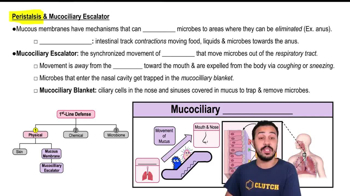
  • What is peristalsis, and what role does it play in innate immunity?

    Peristalsis is the muscle contractions in the intestinal tract that move ingested substances and microbes toward the anus for elimination.
  • Describe the mucociliary escalator and its function.

    The mucociliary escalator is the synchronized movement of cilia in the respiratory tract that moves microbes trapped in mucus toward the mouth for expulsion.
  • How can microbes trapped in mucus be expelled from the respiratory tract?

    They can be expelled by coughing, sneezing, or swallowing the mucus into the digestive tract for elimination.
  • What is the mucociliary blanket, and where is it found?

    The mucociliary blanket is found in the nasal cavity and sinuses, where it traps and helps remove microbes.
  • What is the role of cilia in the mucociliary escalator?

    Cilia beat in a specific direction to move mucus and trapped microbes toward the mouth and nose for elimination.
  • How do peristalsis and the mucociliary escalator work together to protect the body?

    Both mechanisms help move and eliminate microbes from the body, enhancing the protective function of mucus membranes.
  • What happens to microbes that are swallowed after being trapped in mucus?

    They enter the digestive tract, where peristalsis can eliminate them through the anus.
  • Why is mucus described as a 'first line of defense' in innate immunity?

    Because it acts as a physical barrier that traps and helps remove pathogens before they can cause infection.
  • What tissues make up the structure of mucus membranes?

    Mucus membranes consist of epithelial cells and connective tissue.