Back

Members of the Bacterial World definitions

Control buttons has been changed to "navigation" mode.
1/15
  • Microbial World

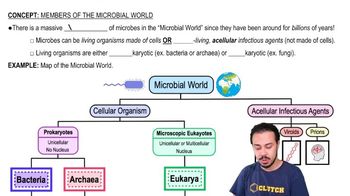
    Encompasses all microscopic life forms, both living and nonliving, including cellular organisms and acellular infectious agents.
  • Prokaryote

    A unicellular organism lacking a nucleus, with genetic material not enclosed within a membrane-bound compartment.
  • Eukaryote

    An organism whose cells contain a nucleus, which can be unicellular or multicellular, and includes microscopic forms.
  • Bacteria

    A domain of prokaryotic, unicellular organisms, distinct from archaea, with unique cellular structures.
  • Archaea

    A domain of prokaryotic, unicellular organisms, fundamentally different from bacteria and eukaryotes.
  • Fungi

    A group of eukaryotic organisms, often studied by microbiologists, that can be unicellular or multicellular.
  • Algae

    Microscopic eukaryotic organisms, classified as protists, capable of photosynthesis and found in aquatic environments.
  • Protozoa

    Microscopic, unicellular eukaryotic organisms, often motile, and classified as protists.
  • Helminths

    Microscopic, multicellular eukaryotic organisms, commonly referred to as parasitic worms.
  • Virus

    An acellular infectious agent, not made of cells, requiring a host to replicate and cause infection.
  • Viroid

    A type of acellular infectious agent, consisting solely of a short strand of RNA, lacking a protein coat.
  • Prion

    An acellular infectious agent composed entirely of misfolded protein, capable of causing neurodegenerative diseases.
  • Cellular Organism

    A living entity composed of one or more cells, classified as either prokaryotic or eukaryotic.
  • Acellular Infectious Agent

    A nonliving entity, not made of cells, capable of causing disease, including viruses, viroids, and prions.
  • Nucleus

    A membrane-bound compartment within eukaryotic cells that houses genetic material.