Back

Measuring Growth by Membrane Filtration quiz

Control buttons has been changed to "navigation" mode.
1/15
  • What is the main purpose of membrane filtration in microbiology?

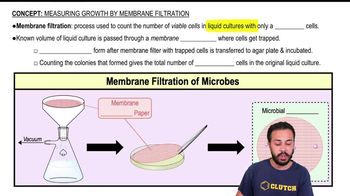
    Membrane filtration is used to count the number of viable (living) cells in liquid cultures with low cell concentrations.
  • Why must the membrane filter have very small pores in the filtration process?

    The pores must be smaller than the cells to trap the cells on the membrane filter while allowing the liquid to pass through.
  • What happens to the membrane filter after filtration is complete?

    The membrane filter with trapped cells is transferred to an agar plate and incubated to allow colonies to form.
  • What do the colonies that form on the membrane filter represent?

    The colonies represent colony forming units, which indicate individual viable cells from the original sample.
  • How is the total number of viable cells in the original culture determined using membrane filtration?

    By counting the number of colonies that form on the membrane after incubation, you determine the total number of viable cells.
  • Why is membrane filtration especially useful for cultures with low cell concentrations?

    It allows for the visualization and quantification of microbial growth even when only a few cells are present in the sample.
  • What is the first step in the membrane filtration process?

    A known volume of liquid culture is poured onto the membrane filter.
  • How are the cells separated from the liquid in membrane filtration?

    A vacuum pulls the liquid through the filter, while the cells are trapped on the membrane due to the small pore size.
  • What is the role of the agar plate in membrane filtration?

    The agar plate provides nutrients and a surface for the trapped cells to grow and form visible colonies.
  • What does each colony on the membrane filter typically originate from?

    Each colony typically originates from a single viable cell that was trapped on the membrane.
  • What is meant by 'colony forming unit' in the context of membrane filtration?

    A colony forming unit (CFU) is an individual viable cell capable of forming a colony on the agar plate.
  • Why is it important to use a known volume of liquid culture in membrane filtration?

    Using a known volume allows for accurate calculation of cell concentration in the original sample.
  • What is the significance of incubating the membrane filter after transferring it to the agar plate?

    Incubation allows the trapped viable cells to grow and form visible colonies for counting.
  • How does membrane filtration help in quantifying microbial growth?

    It enables direct counting of viable cells by counting the colonies that form after incubation.
  • What is the final outcome of the membrane filtration method in measuring microbial growth?

    The final outcome is the total count of viable cells in the original liquid culture, determined by the number of colonies formed.