Back

Liquid Chemicals: Halogens quiz

Control buttons has been changed to "navigation" mode.
1/15
  • What are halogens and how do they control microbial growth?

    Halogens are highly reactive oxidizing agents that damage proteins and other cell components, thereby controlling microbial growth.
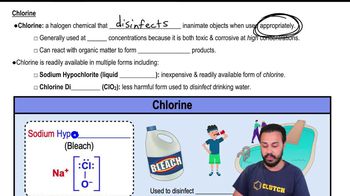
  • Which two halogens are most commonly used as disinfectants?

    Chlorine and iodine are the most commonly used halogens for disinfection.
  • At what concentrations is chlorine typically used for disinfection and why?

    Chlorine is used at very low concentrations because it is toxic and corrosive at high concentrations.
  • What harmful byproduct can form when chlorine reacts with organic matter?

    Chlorine can form carcinogenic products when it reacts with organic matter.
  • What is sodium hypochlorite and how is it commonly used?

    Sodium hypochlorite is liquid bleach and is an inexpensive, readily available form of chlorine used to disinfect surfaces.
  • What is chlorine dioxide and what is its primary use?

    Chlorine dioxide (ClO2) is a less harmful form of chlorine mainly used to disinfect drinking water.
  • How does the form and concentration of chlorine affect its use?

    The form and concentration of chlorine determine whether it is used to disinfect inanimate objects, swimming pools, or drinking water.
  • Why must the use of chlorine be managed appropriately?

    Chlorine must be managed properly to avoid toxicity, corrosiveness, and the formation of harmful byproducts.
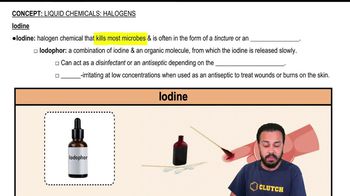
  • What is a tincture of iodine?

    A tincture of iodine is iodine dissolved in an alcohol-based solution, used as a disinfectant.
  • What is an iodophor and how does it differ from a tincture?

    An iodophor is a combination of iodine and an organic molecule that releases iodine slowly, making it less irritating to the skin than a tincture.
  • In what situations is an iodophor preferred over a tincture?

    An iodophor is preferred when treating wounds or burns because it is less irritating to the skin, especially at low concentrations.
  • How does iodine act as a disinfectant or antiseptic?

    Iodine kills most microbes and can be used as a disinfectant or antiseptic depending on its form and concentration.
  • Why is the slow release of iodine from an iodophor beneficial?

    The slow release reduces skin irritation, making iodophors suitable for antiseptic use on wounds and burns.
  • What factors influence the effectiveness and safety of halogen use?

    The form and concentration of the halogen, as well as proper management, influence its effectiveness and safety.
  • What are two common applications of chlorine in public health?

    Chlorine is commonly used to disinfect swimming pools and to treat drinking water.