Skip to main content
Microbiology
My Course
Learn
Exam Prep
AI Tutor
Study Guides
Textbook Solutions
Flashcards
Explore
Try the app
My Course
Learn
Exam Prep
AI Tutor
Study Guides
Textbook Solutions
Flashcards
Explore
Try the app
Back
Light Reactions of Photosynthesis definitions
You can tap to flip the card.
Thylakoid
You can tap to flip the card.
👆
Thylakoid
Green, pancake-shaped structure inside chloroplasts where the light reactions and related processes occur.
Track progress
Control buttons has been changed to "navigation" mode.
1/15
Related flashcards
Related practice
Recommended videos
Light Reactions of Photosynthesis quiz #1
Light Reactions of Photosynthesis
10 Terms
Light Reactions of Photosynthesis
13. Photosynthesis
1 problem
Topic
Monica
Cyclic vs. Non-Cyclic Photophosphorylation
13. Photosynthesis
3 problems
Topic
Monica
13. Photosynthesis
9 topics
12 problems
Chapter
Brendan
Guided course
01:48
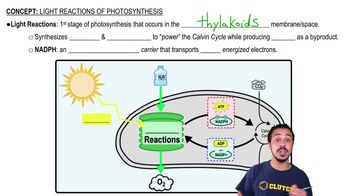
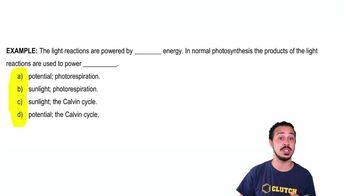
Light Reactions of Photosynthesis Example 1
6
views
Guided course
04:06
Light Reactions of Photosynthesis
9
views
Guided course
15:15
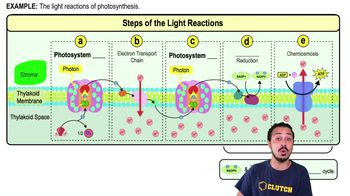
Steps of the Light Reactions
5
views
Terms in this set (15)
Hide definitions
Thylakoid
Green, pancake-shaped structure inside chloroplasts where the light reactions and related processes occur.
Chloroplast
Organelle in plant cells housing thylakoids and stroma, serving as the site for photosynthesis.
Photosystem II
Light-harvesting complex that initiates the light reactions by absorbing photons and energizing electrons from water.
Photosystem I
Light-harvesting complex that re-energizes electrons with photons, enabling their transfer to NADP+.
Electron Transport Chain
Series of molecules in the thylakoid membrane that shuttle electrons, creating a proton gradient for ATP synthesis.
Photon
Unit of solar energy absorbed by photosystems to energize electrons during the light reactions.
NADP+
Final electron acceptor in the light reactions, reduced to a high-energy electron carrier used in the Calvin Cycle.
NADPH
Electron carrier formed by the reduction of NADP+, transporting energized electrons to the Calvin Cycle.
ATP
Molecule produced during chemiosmosis, providing chemical energy for the Calvin Cycle.
Chemiosmosis
Process using a proton gradient across the thylakoid membrane to drive ATP synthesis via ATP synthase.
ATP Synthase
Enzyme embedded in the thylakoid membrane that synthesizes ATP as protons flow through it.
Oxygen
Byproduct released when water molecules are split during the light reactions, often exiting through leaf stomata.
Stroma
Fluid-filled region surrounding thylakoids in chloroplasts, where the Calvin Cycle takes place.
Proton Gradient
Difference in hydrogen ion concentration across the thylakoid membrane, essential for ATP production.
Calvin Cycle
Second stage of photosynthesis that uses ATP and NADPH from the light reactions to fix carbon.
 BackBack
 01:48
01:48