Skip to main content
Microbiology
My Course
Learn
Exam Prep
AI Tutor
Study Guides
Textbook Solutions
Flashcards
Explore
Try the app
My Course
Learn
Exam Prep
AI Tutor
Study Guides
Textbook Solutions
Flashcards
Explore
Try the app
Back
Leaf & Chloroplast Anatomy quiz
You can tap to flip the card.
What is the mesophyll in a leaf?
You can tap to flip the card.
👆
What is the mesophyll in a leaf?
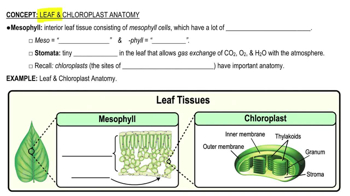
The mesophyll is the interior leaf tissue made up of mesophyll cells, which contain many chloroplasts and are responsible for photosynthesis.
Track progress
Control buttons has been changed to "navigation" mode.
1/15
Related flashcards
Related practice
Recommended videos
Leaf & Chloroplast Anatomy definitions
Leaf & Chloroplast Anatomy
13 Terms
Leaf & Chloroplast Anatomy
13. Photosynthesis
1 problem
Topic
Brendan
Electromagnetic Spectrum
13. Photosynthesis
1 problem
Topic
Nicole
13. Photosynthesis
9 topics
13 problems
Chapter
Nicole
08:18
Leaf & Chloroplast Anatomy
8
views
Terms in this set (15)
Hide definitions
What is the mesophyll in a leaf?
The mesophyll is the interior leaf tissue made up of mesophyll cells, which contain many chloroplasts and are responsible for photosynthesis.
What do mesophyll cells contain that is crucial for photosynthesis?
Mesophyll cells contain numerous chloroplasts, the organelles where photosynthesis occurs.
What is the meaning of the roots 'meso' and 'phil' in the word 'mesophyll'?
'Meso' means middle and 'phil' means leaf, so 'mesophyll' refers to the middle or interior leaf tissue.
What are stomata and what is their function?
Stomata are small openings or pores on the leaf surface that regulate gas exchange (CO2, O2, and water vapor) with the environment.
How do stomata contribute to photosynthesis?
Stomata allow the exchange of gases necessary for photosynthesis, such as carbon dioxide entering and oxygen leaving the leaf.
What is the difference between stomata and stroma?
Stomata are pores on the leaf surface for gas exchange, while stroma is the fluid-filled space inside the chloroplast surrounding the thylakoids.
What are the two membranes found in chloroplasts?
Chloroplasts have an outer membrane and an inner membrane that surround the organelle.
What are thylakoids and where are they found?
Thylakoids are green, pancake-like structures found inside chloroplasts, where the light-dependent reactions of photosynthesis occur.
What is a granum (or grana) in chloroplast anatomy?
A granum is a stack of thylakoids within the chloroplast; 'grana' is the plural form.
Where is the stroma located in the chloroplast?
The stroma is the fluid-filled space inside the chloroplast, surrounding the thylakoids.
What powers photosynthesis in chloroplasts?
Photosynthesis is powered by electromagnetic waves of light, which are absorbed by chloroplasts.
What happens when stomata are open?
When stomata are open, they allow for gas exchange between the leaf and the environment, enabling photosynthesis to proceed.
What gases are exchanged through the stomata?
Carbon dioxide, oxygen, and water vapor are exchanged through the stomata.
What is the main function of chloroplasts in mesophyll cells?
Chloroplasts are the site of photosynthesis, converting light energy into chemical energy for the plant.
Why is it important not to confuse stomata with stroma?
Stomata are leaf pores for gas exchange, while stroma is the internal fluid of the chloroplast; they have different functions and locations.
 BackBack
 08:18
08:18