Skip to main content
Microbiology
My Course
Learn
Exam Prep
AI Tutor
Study Guides
Textbook Solutions
Flashcards
Explore
Try the app
My Course
Learn
Exam Prep
AI Tutor
Study Guides
Textbook Solutions
Flashcards
Explore
Try the app
Back
Leading & Lagging DNA Strands quiz
You can tap to flip the card.
What are the two types of DNA strands formed at the replication fork during DNA replication?
You can tap to flip the card.
👆
What are the two types of DNA strands formed at the replication fork during DNA replication?
The two types are the leading strand and the lagging strand.
Track progress
Control buttons has been changed to "navigation" mode.
1/15
Related flashcards
Related practice
Recommended videos
Leading & Lagging DNA Strands definitions
Leading & Lagging DNA Strands
12 Terms
Leading & Lagging DNA Strands
14. DNA Replication
3 problems
Topic
Brendan
Steps of DNA Replication
14. DNA Replication
4 problems
Topic
Brendan
14. DNA Replication
10 topics
14 problems
Chapter
Brendan
Guided course
05:15
Leading & Lagging DNA Strands
3
views
Terms in this set (15)
Hide definitions
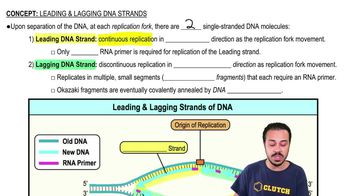
What are the two types of DNA strands formed at the replication fork during DNA replication?
The two types are the leading strand and the lagging strand.
In which direction is the leading DNA strand synthesized relative to the replication fork movement?
The leading strand is synthesized continuously in the same direction as the replication fork movement.
How many RNA primers are required for the synthesis of the leading DNA strand?
Only one RNA primer is required for the leading strand.
How is the lagging DNA strand synthesized in relation to the replication fork movement?
The lagging strand is synthesized discontinuously in the opposite direction of the replication fork movement.
What are the short DNA segments called that are formed on the lagging strand?
They are called Okazaki fragments.
Who are Okazaki fragments named after?
They are named after the Japanese scientist Okazaki.
Why does the lagging strand require multiple RNA primers?
Each Okazaki fragment on the lagging strand requires its own RNA primer for synthesis.
What enzyme joins the Okazaki fragments together on the lagging strand?
DNA ligase covalently anneals the Okazaki fragments to form a continuous DNA strand.
Why are Okazaki fragments necessary on the lagging strand?
They are necessary because DNA polymerase can only synthesize DNA in the 5' to 3' direction.
What happens to the RNA primers after DNA synthesis is complete?
The RNA primers are replaced with DNA.
At each replication fork, how many leading and lagging strands are present?
There is one leading strand and one lagging strand at each replication fork.
What is the origin of replication?
It is the sequence of DNA where DNA replication begins.
How does the direction of the leading strand compare to the movement of the replication fork?
The leading strand is built in the same direction as the replication fork movement.
How does the direction of the lagging strand compare to the movement of the replication fork?
The lagging strand is built in the opposite direction of the replication fork movement.
What is the main limitation of DNA polymerase that affects lagging strand synthesis?
DNA polymerase can only synthesize DNA in the 5' to 3' direction, necessitating discontinuous synthesis on the lagging strand.
 BackBack
 05:15
05:15