Back

Laws of Thermodynamics definitions

Control buttons has been changed to "navigation" mode.
1/15
  • Thermodynamics

    Study of energy and its transfers between substances and forms, focusing on universal principles governing these changes.
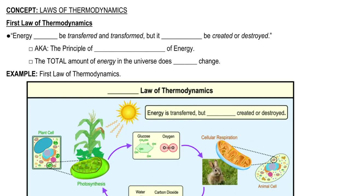
  • First Law of Thermodynamics

    Principle stating that energy is conserved in the universe, only transferred or transformed, never created or destroyed.
  • Conservation of Energy

    Concept that total energy remains constant during any process, with no net gain or loss in the universe.
  • Kinetic Energy

    Form of energy associated with motion, including heat, which is transferred between objects of different temperatures.
  • Potential Energy

    Stored energy based on position or arrangement, which can be converted into other energy forms.
  • Photosynthesis

    Process in plants where solar energy is converted into chemical energy, producing glucose and oxygen.
  • Chloroplast

    Organelle in plant cells responsible for capturing solar energy and driving the process of photosynthesis.
  • Mitochondria

    Organelle in animal cells where chemical energy from nutrients is converted into ATP through cellular respiration.
  • ATP

    Molecule serving as the main energy currency in cells, produced during cellular respiration for cellular activities.
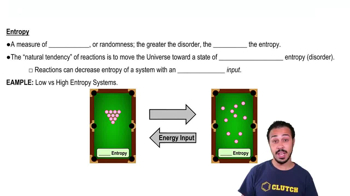
  • Entropy

    Measure of disorder or randomness in a system, with higher values indicating greater disorganization.
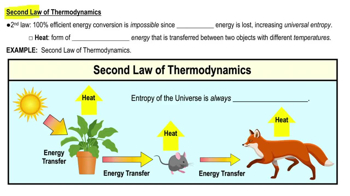
  • Second Law of Thermodynamics

    Principle stating that energy conversions are never 100% efficient, always increasing universal entropy.
  • Heat

    Form of kinetic energy lost during energy transfers, not usable by organisms, contributing to increased entropy.
  • Chemical Energy

    Energy stored within molecular bonds, such as glucose, available for biological processes.
  • Cellular Respiration

    Process in cells where chemical energy from glucose is converted into ATP, releasing carbon dioxide and water.
  • Solar Energy

    Energy originating from the sun, serving as the primary source for life and driving photosynthesis.