Back

Introduction to Types of RNA definitions

Control buttons has been changed to "navigation" mode.
1/13
  • mRNA

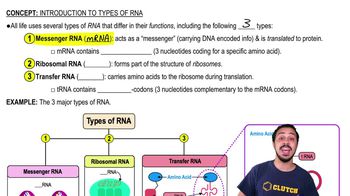
    Acts as a messenger carrying DNA-encoded instructions, containing codons that specify amino acids during protein synthesis.
  • rRNA

    Forms a structural component of ribosomes, playing a key role in translation but not itself translated into protein.
  • tRNA

    Carries amino acids to the ribosome, featuring anticodons that pair with mRNA codons during translation.
  • Codon

    A sequence of three nucleotides in mRNA that codes for a specific amino acid in protein synthesis.
  • Anticodon

    A three-nucleotide sequence on tRNA that is complementary to an mRNA codon, ensuring correct amino acid placement.
  • Ribosome

    A complex molecular machine composed partly of rRNA, essential for translating mRNA into protein.
  • Translation

    The cellular process where ribosomes synthesize proteins using mRNA as a template and tRNA for amino acid delivery.
  • Amino Acid

    A building block of proteins, delivered to the ribosome by tRNA during translation.
  • Nucleotide

    A molecular subunit of RNA, forming sequences such as codons and anticodons that determine genetic information.
  • Protein Synthesis

    The multi-step process involving mRNA, rRNA, and tRNA to assemble amino acids into proteins.
  • Genetic Code

    The set of rules by which nucleotide sequences in mRNA are translated into amino acid sequences in proteins.
  • Single Strand

    The structural form of RNA, allowing molecules like tRNA to fold into complex shapes for their functions.
  • Complementarity

    The specific pairing between codons and anticodons, ensuring accurate translation of genetic information.