Back

Introduction to the Types of Culture Media definitions

Control buttons has been changed to "navigation" mode.
1/14
  • Culture Media

    Solid or liquid nutrient preparations designed to support microbial growth in laboratory settings.
  • Solid Media

    Nutrient preparations with a firm surface, allowing for the isolation and observation of microbial colonies.
  • Liquid Media

    Nutrient solutions without a solidifying agent, used for growing microbes in suspension.
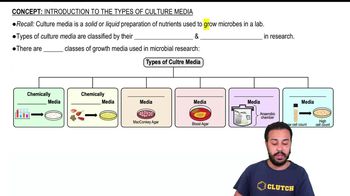
  • Chemically Defined Media

    Growth preparations with precisely known chemical composition, enabling controlled experimental conditions.
  • Chemically Complex Media

    Preparations containing ingredients of unknown exact composition, often supporting a wide range of microbes.
  • Selective Media

    Preparations formulated to favor the growth of specific microbes while inhibiting others, exemplified by McConkey agar.
  • Differential Media

    Preparations that distinguish between microbial species based on observable changes, such as color shifts in blood agar.
  • Reducing Media

    Preparations designed to remove oxygen, facilitating the growth of anaerobic organisms, often used with anaerobic chambers.
  • Enrichment Media

    Preparations that enhance the growth of low-abundance microbes, increasing their numbers for easier study.
  • McConkey Agar

    A selective preparation used to isolate and differentiate certain bacteria, particularly in clinical samples.
  • Blood Agar

    A differential preparation containing blood, used to observe hemolytic reactions among microbial colonies.
  • Anaerobic Chamber

    A sealed environment used to cultivate microbes that cannot tolerate oxygen, often paired with reducing media.
  • Nutrient Preparation

    A mixture of substances providing essential elements for microbial metabolism and growth in laboratory cultures.
  • Microbial Colony

    A visible cluster of microorganisms growing on a solid surface, originating from a single cell or group.