Back

Introduction to Prokaryotic Flagella definitions

Control buttons has been changed to "navigation" mode.
1/13
  • Flagellum

    A long, filamentous surface protein structure responsible for propelling a prokaryotic cell through its environment.
  • Flagella

    Multiple long, whip-like appendages on a cell surface that enable movement and directional motility.
  • Motility

    The ability of a cell to move actively through its environment, often driven by surface appendages.
  • Tuft

    A cluster of several flagella grouped together at a specific region on a bacterial cell surface.
  • Distribution

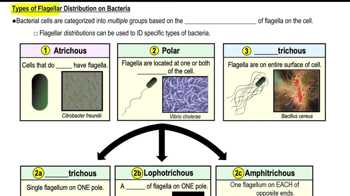
    The arrangement pattern of flagella on a bacterial cell, used to categorize and identify bacteria.
  • Atrichous

    A flagellar distribution type where a bacterial cell lacks any flagella on its surface.
  • Polar

    A flagellar arrangement where flagella are located at one or both ends of a bacterial cell.
  • Monotrichous

    A polar distribution subtype with a single flagellum positioned at one pole of a bacterial cell.
  • Lophotrichous

    A polar distribution subtype with multiple flagella grouped at one pole of a bacterial cell.
  • Amphitrichous

    A polar distribution subtype with one flagellum at each of two opposite poles of a bacterial cell.
  • Peritrichous

    A flagellar distribution where flagella are spread over the entire surface of a bacterial cell.
  • Identification

    The process of distinguishing bacterial species based on observable features such as flagellar arrangement.
  • Surface Protein

    A protein structure extending from the cell membrane, often involved in movement or environmental interaction.