Back

Introduction to Metabolism quiz

Control buttons has been changed to "navigation" mode.
1/15
  • What does the term metabolism refer to in biology?

    Metabolism refers to all of the chemical reactions that occur within an organism.
  • What is a metabolic pathway?

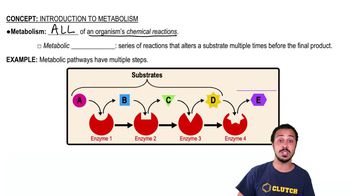
    A metabolic pathway is a series of chemical reactions that alter a substrate through multiple steps, each catalyzed by a specific enzyme, until a final product is produced.
  • How do enzymes function in metabolic pathways?

    Enzymes work together in a sequence, each catalyzing a specific step to convert substrates into products along the pathway.
  • What are the two main types of metabolic pathways?

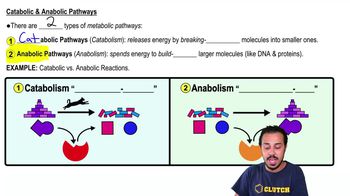
    The two main types are catabolic pathways (catabolism) and anabolic pathways (anabolism).
  • What is the primary function of catabolic pathways?

    Catabolic pathways break down larger molecules into smaller ones, releasing energy in the soprocess.
  • What is the primary function of anabolic pathways?

    Anabolic pathways build larger molecules from smaller ones and require an input of energy.
  • Which type of metabolic pathway is associated with exergonic processes?

    Catabolic pathways are associated with exergonic processes because they release energy.
  • Which type of metabolic pathway is associated with endergonic processes?

    Anabolic pathways are associated with endergonic processes because they require energy input.
  • How can you remember the function of catabolism using an analogy?

    You can remember catabolism by thinking of a cat breaking down a pyramid into smaller pieces.
  • What is the analogy used to describe anabolism?

    Anabolism is compared to building up a pyramid from smaller building blocks.
  • In a metabolic pathway, what happens to the initial substrate?

    The initial substrate is converted stepwise into intermediate products by enzymes until the final product is formed.
  • What role do enzymes play in the conversion of substrates in metabolic pathways?

    Each enzyme catalyzes a specific step, converting one substrate into another until the pathway is complete.
  • What is the difference between the energy changes in catabolic and anabolic pathways?

    Catabolic pathways release energy, while anabolic pathways require energy input.
  • Give an example of a molecule that might be built by an anabolic pathway.

    DNA and proteins are examples of molecules built by anabolic pathways.
  • Why can't a cat be used as an analogy for anabolism?

    Because a cat can only break things down (like in catabolism), not build them up as in anabolism.