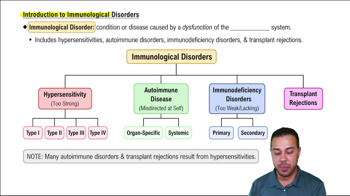
An immunological disorder is a condition caused by dysfunction of the immune system, which may be too strong, too weak, or misdirected.
What are the four main categories of immunological disorders?
The four main categories are hypersensitivities, autoimmune disorders, immunodeficiency disorders, and transplant rejections.
What is hypersensitivity in the context of immunological disorders?
Hypersensitivity is an exaggerated, harmful immune system overreaction that occurs after sensitization to an antigen.
What does the term 'sensitization' mean in hypersensitivity reactions?
Sensitization is the immune system's first exposure to an antigen, preparing it to react in subsequent exposures but not causing a response on the first exposure.
Which hypersensitivity type is most commonly associated with allergic reactions?
Type I hypersensitivity is most commonly associated with allergic reactions and is mediated by IgE antibodies.
What is the main mechanism of Type II hypersensitivity?
Type II hypersensitivity involves antibodies binding to antigens on cell surfaces, leading to cytotoxic cell death.
What is a classic example of Type II hypersensitivity?
A classic example is hemolytic transfusion reactions caused by improper blood transfusions.
What causes Type III hypersensitivity reactions?
Type III hypersensitivity is caused by the formation and accumulation of immune complexes, leading to inflammation.
Which disease is a classic example of Type III hypersensitivity?
Rheumatoid arthritis is a classic example, where immune complexes accumulate in the joints and cause inflammation.
How are Type IV hypersensitivity reactions different from Types I-III?
Type IV hypersensitivity is mediated by T cells and is delayed, unlike Types I-III, which are mediated by antibodies.
What is a classic example of Type IV hypersensitivity?
A classic example is the rash caused by contact with poison ivy.
What does the acronym 'ACID' help you remember about hypersensitivity types?
ACID stands for Allergic (Type I), Cytotoxic (Type II), Immune complex (Type III), and Delayed cell-mediated (Type IV) hypersensitivities.
Do hypersensitivity reactions occur on the first exposure to an antigen?
No, hypersensitivity reactions occur only after sensitization, not on the first exposure.
What factors contribute to the development of hypersensitivities?
Hypersensitivities arise from a combination of genetic and environmental factors.
How are hypersensitivities related to autoimmune diseases and transplant rejections?
Many autoimmune disorders and transplant rejections result from hypersensitivity reactions, showing their interconnectedness.
 Back
Back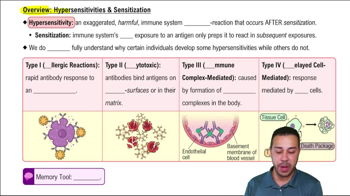
 05:35
05:35