Back

Introduction to Eukaryotic Gene Regulation quiz

Control buttons has been changed to "navigation" mode.
1/15
  • What is the main purpose of eukaryotic gene regulation?

    Eukaryotic gene regulation allows for differential gene expression, enabling different cell types to have unique proteomes despite sharing the same DNA.
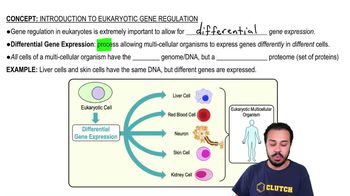
  • What is differential gene expression?

    Differential gene expression is the process by which multicellular organisms express genes differently in different cells, resulting in various cell types.
  • Do all cells in a multicellular organism have the same DNA?

    Yes, all cells have the same genome, but they express different sets of proteins due to gene regulation.
  • What leads to different cell types in multicellular organisms?

    Different cell types arise from differential gene expression, which results in unique proteomes for each cell type.
  • How does gene regulation affect the proteome of a cell?

    Gene regulation determines which proteins are expressed, creating a unique proteome for each cell type.
  • What is the relationship between liver cells and skin cells regarding DNA and proteins?

    Liver and skin cells have the same DNA but express different proteins due to differential gene regulation.
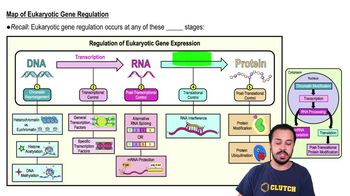
  • At which stages can eukaryotic gene regulation occur?

    Gene regulation can occur at chromatin modifications, transcriptional control, RNA processing, mRNA degradation, translation, and post-translational modifications.
  • What are chromatin modifications?

    Chromatin modifications include changes like histone acetylation and DNA methylation, which control gene accessibility.
  • What is transcriptional control?

    Transcriptional control involves factors that enhance or inhibit the transcription process, affecting gene expression.
  • What is post-transcriptional control?

    Post-transcriptional control includes mRNA processing and degradation, which regulate mRNA stability and translation.
  • What is translational control?

    Translational control regulates the synthesis of proteins from mRNA, impacting protein production.
  • What are post-translational modifications?

    Post-translational modifications alter proteins after translation, affecting their function and lifespan.
  • Where do chromatin modifications, transcription, and RNA processing occur in the cell?

    These processes occur within the nucleus of a eukaryotic cell.
  • Where do mRNA degradation, translation, and post-translational modifications occur?

    These gene regulation strategies occur in the cytoplasm of the cell.
  • What is the significance of the gene regulation map introduced in the lesson?

    The map provides a visual guide to the stages and locations of eukaryotic gene regulation, helping students understand the sequence and cellular context of each regulatory mechanism.