Skip to main content
Microbiology
My Course
Learn
Exam Prep
AI Tutor
Study Guides
Textbook Solutions
Flashcards
Explore
Try the app
My Course
Learn
Exam Prep
AI Tutor
Study Guides
Textbook Solutions
Flashcards
Explore
Try the app
Back
Introduction to DNA Cloning quiz
You can tap to flip the card.
What is DNA cloning?
You can tap to flip the card.
👆
What is DNA cloning?
DNA cloning is the process of creating many identical copies of a specific DNA sequence using living cells.
Track progress
Control buttons has been changed to "navigation" mode.
1/15
Related flashcards
Related practice
Recommended videos
Introduction to DNA Cloning definitions
Introduction to DNA Cloning
15 Terms
Introduction to DNA Cloning
17. Biotechnology
2 problems
Topic
Brendan
Steps to DNA Cloning
17. Biotechnology
4 problems
Topic
Nicole
17. Biotechnology
10 topics
14 problems
Chapter
Brendan
Guided course
02:25
Introduction to DNA Cloning
2
views
Guided course
03:41
Cloning with Recombinant DNA
4
views
Terms in this set (15)
Hide definitions
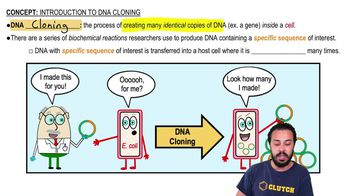
What is DNA cloning?
DNA cloning is the process of creating many identical copies of a specific DNA sequence using living cells.
Which organism is commonly used as a host cell in DNA cloning?
E. coli, a type of bacterial cell, is commonly used as a host cell in DNA cloning.
What is the role of a host cell in DNA cloning?
The host cell replicates the inserted DNA sequence along with its own DNA, producing many copies of the gene of interest.
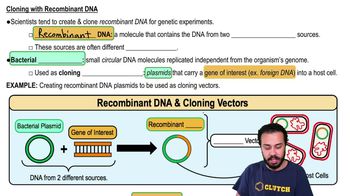
What is recombinant DNA?
Recombinant DNA is a molecule that contains DNA from two different sources, often from different species.
Give an example of two sources that can be combined to make recombinant DNA.
An example is combining DNA from a bacterial plasmid and a human gene.
What are bacterial plasmids?
Bacterial plasmids are small, circular DNA molecules that replicate independently from the bacterial genome.
Why are plasmids important in DNA cloning?
Plasmids serve as cloning vectors, carrying the gene of interest into a host cell for replication.
What is a cloning vector?
A cloning vector is a molecule, such as a plasmid, that can carry foreign DNA into a host cell.
How is recombinant DNA introduced into a host cell?
Recombinant DNA is inserted into the host cell, where it can be replicated during the cell's normal replication process.
What happens to the gene of interest once inside the host cell?
The gene of interest is replicated along with the host cell's DNA, resulting in many copies of the gene.
What is the main purpose of DNA cloning?
The main purpose is to produce multiple identical copies of a specific DNA sequence for study or use.
How do scientists create recombinant DNA?
Scientists combine DNA from a plasmid with a gene of interest from another species to form a single recombinant DNA molecule.
What does it mean for a plasmid to replicate independently?
It means the plasmid can make copies of itself without relying on the replication of the host cell's main genome.
What is the significance of using living cells in DNA cloning?
Living cells provide the machinery needed to replicate the inserted DNA sequence, enabling cloning.
What is the outcome of inserting recombinant DNA into multiple host cells?
Multiple host cells will each replicate the recombinant DNA, producing many copies of the gene of interest.
 BackBack
 02:25
02:25