Back

Introduction to Animal Virus Infections definitions

Control buttons has been changed to "navigation" mode.
1/14
  • Animal Virus Infection

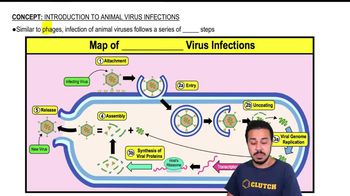
    A process involving sequential steps by which viruses invade and multiply within animal cells, distinct from bacteriophage infections.
  • Bacteriophage

    A virus that specifically infects bacteria, serving as a comparison point for understanding animal virus infection steps.
  • Attachment

    The initial interaction where a virus binds to the surface of a susceptible animal cell, starting the infection process.
  • Entry

    The step where the virus penetrates the host cell membrane, allowing its genetic material access to the cell interior.
  • Uncoating

    A stage following entry where the viral capsid is removed, exposing the viral genome inside the host cell.
  • Viral Genome Replication

    The process by which the virus duplicates its genetic material within the host cell, ensuring new viruses can be produced.
  • Protein Synthesis

    The creation of viral proteins using the host cell's machinery, essential for forming new virus particles.
  • Assembly

    The stage where newly made viral genomes and proteins are put together to form complete virus particles.
  • Release

    The final step where new virus particles exit the host cell, often leading to cell damage or death.
  • Mnemonic

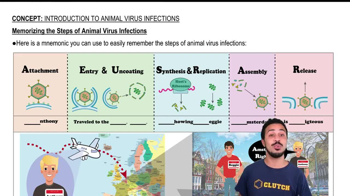
    A memory aid, such as a creative phrase, used to help recall the sequential steps of animal virus infection.
  • Replication

    The duplication of viral genetic material, a critical step for producing progeny viruses within the host.
  • Viral Proteins

    Molecules produced during infection that are necessary for constructing new viruses and facilitating infection.
  • Capsid

    A protein shell that encases the viral genome, removed during uncoating to allow genome access.
  • Map

    A visual guide outlining the sequential steps of animal virus infection, aiding in understanding the process flow.