Back

Inhibitors of Cell Wall Synthesis: Beta-lactam & Penicillin quiz

Control buttons has been changed to "navigation" mode.
1/15
  • What is the main structural feature shared by all beta-lactam antibiotics?

    All beta-lactam antibiotics contain a beta-lactam ring, which is essential for their function in disrupting bacterial cell wall synthesis.
  • How do beta-lactam antibiotics kill bacteria?

    They inhibit the enzymes that cross-link peptidoglycan in the bacterial cell wall, leading to cell wall instability and cell lysis.
  • What is the primary component of the bacterial cell wall targeted by beta-lactam antibiotics?

    The primary component is peptidoglycan, which consists of long strands of alternating NAM and NAG subunits cross-linked by peptides.
  • Why are beta-lactam antibiotics generally ineffective against existing, mature cell walls?

    They only affect new cell wall synthesis, so mature cell walls that are already cross-linked are not disrupted.
  • What is the difference between penicillin G and penicillin V in terms of administration?

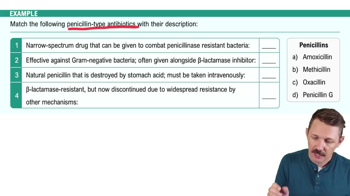
    Penicillin G is destroyed by stomach acid and must be given intravenously, while penicillin V is acid-stable and can be taken orally.
  • What does it mean when a penicillin is described as 'narrow spectrum'?

    It means the drug is mainly effective against gram-positive bacteria and not effective against gram-negative bacteria.
  • What enzyme commonly confers resistance to natural penicillins, and how does it work?

    The enzyme is beta-lactamase (or penicillinase), which cleaves the beta-lactam ring, rendering the antibiotic ineffective.
  • How are semi-synthetic penicillins different from natural penicillins?

    Semi-synthetic penicillins are chemically modified to broaden their spectrum or to resist beta-lactamase, but not both at the same time.
  • What modification allows broad-spectrum penicillins like ampicillin to be effective against gram-negative bacteria?

    They have an added NH2 group that increases polarity, allowing them to pass through porins in the gram-negative outer membrane.
  • Why are broad-spectrum penicillins often combined with beta-lactamase inhibitors?

    Because they are not resistant to beta-lactamase, so inhibitors like clavulanic acid are added to protect the antibiotic from degradation.
  • What is the significance of methicillin in the context of antibiotic resistance?

    Methicillin was a beta-lactamase-resistant penicillin, and MRSA (methicillin-resistant Staphylococcus aureus) is named for its resistance to this drug.
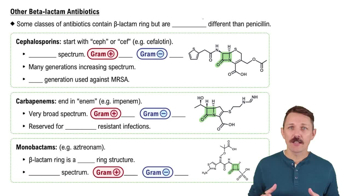
  • How can you recognize a cephalosporin antibiotic by pipeline naming conventions?

    Cephalosporins typically start with 'ceph-' or 'cef-', such as cefazolin or cephalexin.
  • What is a key advantage of later-generation cephalosporins over earlier generations?

    Later generations have a broader spectrum and increased resistance to beta-lactamases, making them effective against resistant bacteria like MRSA.
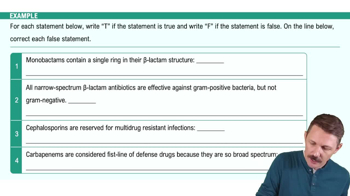
  • What is unique about the structure of monobactams compared to other beta-lactam antibiotics?

    Monobactams have a single beta-lactam ring without a second ring attached, unlike penicillins, cephalosporins, and carbapenems.
  • Against which type of bacteria are monobactams primarily effective?

    Monobactams are narrow spectrum but are generally effective against gram-negative bacteria, not gram-positive bacteria.