Skip to main content
Microbiology
My Course
Learn
Exam Prep
AI Tutor
Study Guides
Textbook Solutions
Flashcards
Explore
Try the app
My Course
Learn
Exam Prep
AI Tutor
Study Guides
Textbook Solutions
Flashcards
Explore
Try the app
Back
Influenza definitions
You can tap to flip the card.
Influenza A
You can tap to flip the card.
👆
Influenza A
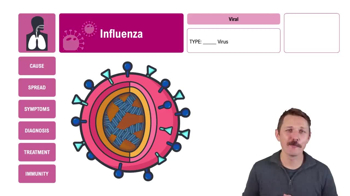
A member of the Orthomyxoviridae family with a segmented, single-stranded RNA genome, responsible for most seasonal and pandemic flu cases.
Track progress
Control buttons has been changed to "navigation" mode.
1/15
Related flashcards
Related practice
Recommended videos
Influenza quiz
Influenza
15 Terms
Pneumonia
30. Microbial Infections - Respiratory System
4 problems
Topic
30. Microbial Infections - Respiratory System
3 topics
7 problems
Chapter
Guided course
05:21
Flu Naming, Antigenic Drift & Shift
2
views
Guided course
06:35
Influenza
1
views
Guided course
03:23
Influenza Example 1
1
views
Terms in this set (15)
Hide definitions
Influenza A
A member of the Orthomyxoviridae family with a segmented, single-stranded RNA genome, responsible for most seasonal and pandemic flu cases.
Segmented Genome
A viral genetic structure composed of multiple separate RNA pieces, allowing for genetic reassortment and rapid evolution.
Hemagglutinin
A glycoprotein spike on the viral surface that binds to host cells, enabling viral entry and determining subtype classification.
Neuraminidase
A surface enzyme that facilitates the release of new viral particles from infected cells, aiding in viral spread.
Glycoprotein Spikes
Surface structures composed of proteins and sugars, crucial for host cell recognition, entry, and immune system targeting.
Antigenic Drift
A process involving minor mutations in surface antigens, leading to new seasonal variants and necessitating annual vaccine updates.
Antigenic Shift
A major genetic reassortment event, often involving animal hosts, resulting in novel viral strains and potential pandemics.
Respiratory Droplets
Tiny particles expelled during coughing or sneezing, serving as the main transmission route for the virus between individuals.
Multivalent Vaccine
An immunization formulation designed to protect against multiple viral strains within a single dose, updated annually.
Rapid Antigen Test
A diagnostic tool providing quick detection of viral proteins from nasal swabs, enabling at-home or clinical flu diagnosis.
PCR Testing
A molecular diagnostic method that amplifies viral RNA, offering high sensitivity for confirming infection and tracking variants.
Oseltamivir
An antiviral medication that inhibits neuraminidase activity, reducing symptom duration and severity when administered early.
Immunity
The body's defense state achieved through prior infection or vaccination, providing protection against specific viral strains.
Subtype Naming System
A classification method using combinations of hemagglutinin and neuraminidase variants, such as H1N1 or H3N2.
Orthomyxoviridae
A family of enveloped RNA viruses characterized by segmented genomes, including agents responsible for influenza.
 BackBack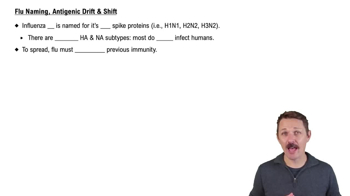
 05:21
05:21