Skip to main content
Microbiology
My Course
Learn
Exam Prep
AI Tutor
Study Guides
Textbook Solutions
Flashcards
Explore
Try the app
My Course
Learn
Exam Prep
AI Tutor
Study Guides
Textbook Solutions
Flashcards
Explore
Try the app
Back
History of Spontaneous Generation Summarized definitions
You can tap to flip the card.
Spontaneous Generation
You can tap to flip the card.
👆
Spontaneous Generation
A historical belief that living organisms can arise from nonliving matter without external influence.
Track progress
Control buttons has been changed to "navigation" mode.
1/15
Related flashcards
Related practice
Recommended videos
History of Spontaneous Generation Summarized quiz
History of Spontaneous Generation Summarized
15 Terms
History of Spontaneous Generation Summarized
2. Disproving Spontaneous Generation
3 problems
Topic
Nicole
John Tyndall's Experiment
2. Disproving Spontaneous Generation
3 problems
Topic
Nicole
2. Disproving Spontaneous Generation
6 topics
11 problems
Chapter
Brendan
03:56
History of Spontaneous Generation Summarized
5
views
Terms in this set (15)
Hide definitions
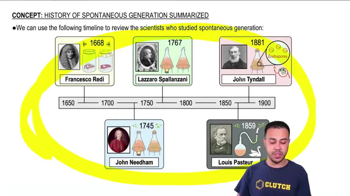
Spontaneous Generation
A historical belief that living organisms can arise from nonliving matter without external influence.
Biogenesis
The principle stating that living organisms originate only from other living organisms.
Francesco Redi
An Italian scientist who challenged the idea that maggots arise from decaying meat without fly involvement.
John Needham
An English scientist whose flawed experiments seemed to support the idea that microbes arise spontaneously.
Lazzaro Spallanzani
A scientist who improved experimental methods, showing that sealing flasks and longer boiling prevent microbial growth.
Louis Pasteur
A scientist who designed the swan neck flask, demonstrating that microbes do not arise without contamination.
John Tyndall
A scientist who explained failed experiment replications by identifying heat-resistant microbes in broths.
Swan Neck Flask
A curved glass apparatus that allows air but traps dust, preventing microbial contamination in experiments.
Endospore
A highly resistant microbial structure capable of surviving extreme heat and explaining persistent contamination.
Microbial Growth
The increase in number of microorganisms, often observed in nutrient-rich broths during experiments.
Experimental Setup
The specific arrangement and procedures used in scientific investigations to test hypotheses.
Vital Source
A hypothesized essential element from air once thought necessary for the origin of life in flasks.
Decaying Meat
Organic material used in early experiments to test the origin of maggots and microbial life.
Replication
The process of repeating experiments to confirm results and ensure scientific reliability.
Contamination
The unintended introduction of microbes into experimental setups, often leading to misleading results.
 BackBack
 03:56
03:56