Skip to main content
Microbiology
My Course
Learn
Exam Prep
AI Tutor
Study Guides
Textbook Solutions
Flashcards
Explore
Try the app
My Course
Learn
Exam Prep
AI Tutor
Study Guides
Textbook Solutions
Flashcards
Explore
Try the app
Back
Helminthic Diseases of the Digestive System definitions
You can tap to flip the card.
Tapeworm
You can tap to flip the card.
👆
Tapeworm
A segmented flatworm lacking a digestive system, absorbing nutrients through its body wall, and capable of reaching several meters in length.
Track progress
Control buttons has been changed to "navigation" mode.
1/15
Related flashcards
Related practice
Recommended videos
Helminthic Diseases of the Digestive System quiz
Helminthic Diseases of the Digestive System
15 Terms
Helminthic Diseases of the Digestive System
31. Microbial Infections - Digestive System
4 problems
Topic
Protozoan Diseases of the Digestive System
31. Microbial Infections - Digestive System
5 problems
Topic
31. Microbial Infections - Digestive System
5 topics
12 problems
Chapter
Guided course
05:49
Tapeworms
2
views
Guided course
06:56
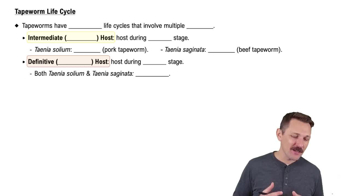
Tapeworm Life Cycle
5
views
Guided course
04:05
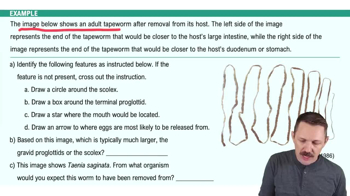
Helminthic Diseases of the Digestive System Example 1
2
views
Terms in this set (15)
Hide definitions
Tapeworm
A segmented flatworm lacking a digestive system, absorbing nutrients through its body wall, and capable of reaching several meters in length.
Cestoda
The biological class of flatworms characterized by segmented bodies and parasitic life cycles involving multiple hosts.
Scolex
An attachment organ at the anterior end, equipped with suckers or hooks, anchoring the parasite to the intestinal wall.
Proglottid
A repeating body segment containing reproductive organs, which matures and fills with eggs as it moves away from the attachment organ.
Gravid Proglottid
A terminal segment distended with eggs, often shed or ruptured to release eggs into the host's feces.
Taenia saginata
A species acquired from undercooked beef, with cattle as the intermediate host and humans as the definitive host.
Taenia solium
A species acquired from undercooked pork, with pigs as the intermediate host and humans as the definitive host.
Intermediate Host
An organism harboring the larval stage, typically cattle or pigs, where immature forms develop in muscle tissue.
Definitive Host
An organism, usually human, where the adult parasite resides, matures, and reproduces in the intestine.
Cysticercus
A larval form encysted in muscle tissue, infectious when consumed in undercooked meat, and capable of developing into an adult worm.
Cysticercosis
A condition resulting from larval migration into human tissues, potentially affecting muscles, eyes, or brain with serious symptoms.
Praziquantel
A medication effective in a single dose for eliminating adult intestinal parasites by disrupting their integrity.
Niclosamide
A drug administered as a single dose to treat intestinal tapeworm infections by inhibiting parasite energy production.
Sanitation
A preventive measure involving proper waste management to block transmission of eggs to intermediate hosts.
Fecal-Oral Contamination
A transmission route where eggs from human waste contaminate food or water, leading to infection in animals or humans.
 BackBack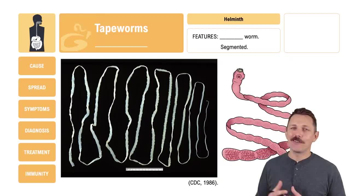
 05:49
05:49