Back

Healthcare-Associated Infections quiz

Control buttons has been changed to "navigation" mode.
1/15
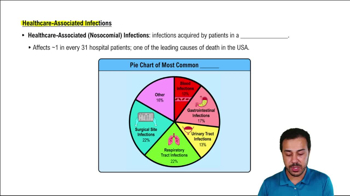
  • What is a healthcare-associated infection (HAI)?

    An HAI is an infection acquired by patients in a hospital or healthcare setting.
  • Approximately what percentage of hospital patients are affected by HAIs?

    About 3% of hospital patients are affected by HAIs.
  • Where do HAIs rank among causes of death in the USA?

    HAIs are among the top 10 leading causes of death in the USA.
  • Which two types of infections make up about 44% of all HAIs?

    Surgical site and respiratory infections together make up about 44% of all HAIs.
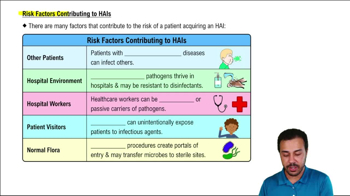
  • Why is it important to isolate certain patients in hospitals?

    Isolation helps prevent the spread of communicable or contagious diseases to other patients.
  • How can the hospital environment contribute to HAIs?

    Hospital surfaces and objects can harbor opportunistic pathogens, some of which may be resistant to disinfectants.
  • Why are healthcare workers considered a risk factor for HAIs?

    Healthcare workers can be active or passive carriers of pathogens, potentially introducing them to patients.
  • How can patient visitors increase the risk of HAIs?

    Visitors may unintentionally bring pathogens from outside into the healthcare setting, exposing patients to new infectious agents.
  • How can a patient's own normal flora cause an HAI?

    Invasive procedures can transfer normal flora to sterile sites, leading to infections.
  • What percentage of HAIs are related to surgical procedures?

    About 22% of all HAIs result from surgical procedures.
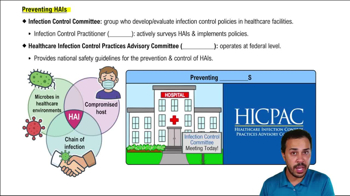
  • What three components must interact for an HAI to occur?

    Microbes and healthcare environments, the chain of infection, and a compromised host must interact for an HAI to occur.
  • What is the role of an infection control committee in a hospital?

    The infection control committee develops and evaluates infection control policies to prevent HAIs.
  • What does an infection control practitioner (ICP) do?

    An ICP actively surveys HAIs and implements infection control policies on a day-to-day basis.
  • What is HICPAC and what is its function?

    HICPAC is the Healthcare Infection Control Practices Advisory Committee, part of the CDC, which provides national safety guidelines for preventing and controlling HAIs.
  • Why is handwashing important in preventing HAIs?

    Frequent handwashing with soap and water helps minimize the risk of acquiring or spreading HAIs.