Back

First-Line Defenses: Chemical Barriers quiz

Control buttons has been changed to "navigation" mode.
1/15
  • What is sebum and how does it function as a chemical barrier in innate immunity?

    Sebum is an oily substance produced by sebaceous glands that lowers skin pH and inhibits microbial growth.
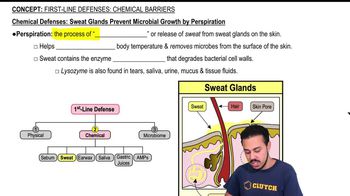
  • How does sweat contribute to the first line of defense against microbes?

    Sweat contains lysozyme, which degrades bacterial cell walls, and helps remove microbes from the skin surface.
  • What enzyme found in sweat, saliva, and tears helps protect against bacterial infections?

    Lysozyme is the enzyme that degrades bacterial cell walls, providing antimicrobial protection.
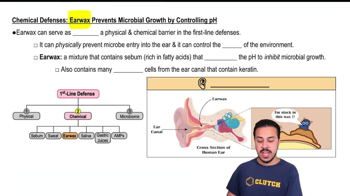
  • In what two ways does earwax act as a barrier to microbial entry?

    Earwax acts as both a physical barrier by trapping microbes and a chemical barrier by lowering pH to inhibit microbial growth.
  • How does the pH of earwax affect microbial growth?

    The low pH of earwax inhibits the growth of many microbes, helping to protect the ear canal.
  • What role does keratin in earwax play in defense?

    Keratin from skin cells in earwax creates a dry environment that further inhibits microbial growth.
  • How does saliva function as a chemical barrier in the mouth?

    Saliva contains enzymes like lysozyme that degrade bacterial cell walls and inhibit microbial growth.
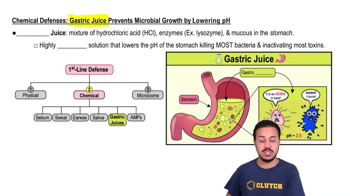
  • What is the main antimicrobial component of gastric juice and how does it work?

    Hydrochloric acid in gastric juice creates a highly acidic environment that kills most ingested bacteria and inactivates toxins.
  • What is the approximate pH of gastric juice and why is this important?

    The pH of gastric juice is about 2.5, which is highly acidic and lethal to most microbes.
  • What are antimicrobial peptides (AMPs) and what is their general function?

    AMPs are short chains of amino acids with antimicrobial activity that damage microbial membranes.
  • What is a defensin and how does it protect the body?

    Defensins are positively charged AMPs that insert into microbial membranes, causing lysis and cell death.
  • Which cells produce defensins and where do they act?

    Epithelial cells produce defensins, which protect the skin and mucous membranes from infection.
  • Name three body fluids or secretions that contain lysozyme.

    Lysozyme is found in sweat, saliva, and tears.
  • How do AMPs respond to the presence of invading microbes?

    AMPs are generally produced in response to invading microbes and act to disrupt their membranes.
  • List at least three types of chemical barriers that are part of the first line of defense in innate immunity.

    Sebum, sweat, earwax, saliva, gastric juices, and antimicrobial peptides (AMPs) are all chemical barriers.