Back

Eukaryotic Post-Transcriptional Regulation quiz

Control buttons has been changed to "navigation" mode.
1/15
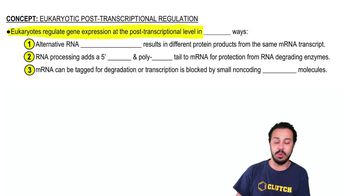
  • What are the three main mechanisms of eukaryotic post-transcriptional regulation?

    The three main mechanisms are alternative RNA splicing, RNA processing for protection, and RNA interference.
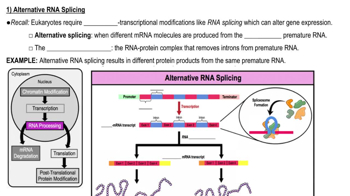
  • What is alternative RNA splicing?

    Alternative RNA splicing is the process where different mRNA molecules are produced from the same pre-mRNA, resulting in various protein products from a single gene.
  • What complex is responsible for removing introns and splicing exons during RNA splicing?

    The spliceosome, a complex of RNA and protein, removes introns and splices exons together.
  • How does alternative RNA splicing contribute to protein diversity?

    It allows a single gene to produce multiple protein products by generating different mRNA transcripts.
  • What modifications are added to mRNA during RNA processing for protection?

    A 5' cap and a poly-A tail are added to the mRNA transcript.
  • Where does RNA processing, including the addition of the 5' cap and poly-A tail, occur?

    RNA processing occurs within the nucleus.
  • Why is mRNA protection important in the cytoplasm?

    It prevents mRNA from being degraded by cytoplasmic enzymes, allowing translation to occur.
  • What happens to unprotected mRNA in the cytoplasm?

    Unprotected mRNA is degraded by enzymes, preventing protein production and turning off gene expression.
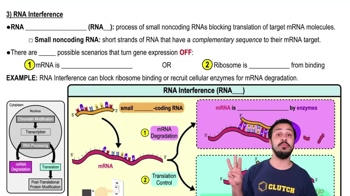
  • What is RNA interference (RNAi)?

    RNA interference is the process where small non-coding RNAs block translation or mark mRNA for degradation, turning off gene expression.
  • What are the two main outcomes of RNA interference?

    RNA interference can either degrade target mRNA or block ribosome binding, preventing translation.
  • What types of small non-coding RNAs are involved in RNA interference?

    MicroRNAs (miRNAs) and small interfering RNAs (siRNAs) are involved in RNA interference.
  • How do microRNAs and siRNAs regulate gene expression?

    Both bind to target mRNA by complementary base pairing and turn off gene expression by marking mRNA for degradation or blocking translation.
  • What is the structural difference between microRNAs and siRNAs?

    MicroRNAs have a single-stranded precursor, while siRNAs have a double-stranded precursor.
  • How does RNA interference turn off gene expression?

    By either degrading the mRNA or preventing ribosome binding, RNA interference stops protein production.
  • What is the effect of adding a 5' cap and poly-A tail to mRNA?

    These modifications protect mRNA from degradation and enable its translation into protein, turning gene expression on.