Back

Disease Transmission definitions

Control buttons has been changed to "navigation" mode.
1/13
  • Chain of Infection

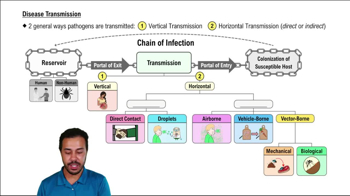
    A sequence of steps describing how a pathogen moves from its source to a new host, including exit, transmission, and entry.
  • Pathogen

    A microorganism or agent capable of causing disease, often transferred between hosts through various routes.
  • Reservoir

    A natural habitat or source where a pathogen normally lives and multiplies before infecting new hosts.
  • Portal of Exit

    A specific route by which a pathogen leaves its reservoir to initiate transmission to another host.
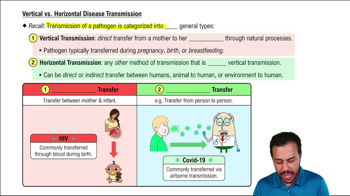
  • Vertical Transmission

    Direct transfer of a pathogen from mother to infant during pregnancy, birth, or breastfeeding.
  • Horizontal Transmission

    Any method of pathogen transfer not involving mother-to-infant, including person-to-person or environment-to-person.
  • Direct Transmission

    Immediate transfer of a pathogen from the reservoir to a host without intermediaries, such as physical contact.
  • Indirect Transmission

    Transfer of a pathogen to a host via an intermediate object, organism, or environmental source.
  • Airborne Transmission

    Spread of infectious agents through the air, often via droplets or particles inhaled by a susceptible host.
  • Infection Control

    Strategies and practices aimed at preventing the spread of pathogens within populations or healthcare settings.
  • Epidemiology

    The scientific study of disease patterns, causes, and effects within populations to inform public health actions.
  • COVID-19

    A respiratory disease caused by a novel coronavirus, commonly spread through airborne transmission.
  • HIV

    A virus that impairs the immune system and is notable for its ability to be transferred from mother to child.