Skip to main content
Microbiology
My Course
Learn
Exam Prep
AI Tutor
Study Guides
Textbook Solutions
Flashcards
Explore
Try the app
My Course
Learn
Exam Prep
AI Tutor
Study Guides
Textbook Solutions
Flashcards
Explore
Try the app
Back
Cyclic vs. Non-Cyclic Photophosphorylation definitions
You can tap to flip the card.
Photophosphorylation
You can tap to flip the card.
👆
Photophosphorylation
Phosphorylation of ADP to ATP using solar energy during the light reactions, providing energy for cellular processes.
Track progress
Control buttons has been changed to "navigation" mode.
1/13
Related flashcards
Related practice
Recommended videos
Cyclic vs. Non-Cyclic Photophosphorylation quiz
Cyclic vs. Non-Cyclic Photophosphorylation
15 Terms
Cyclic vs. Non-Cyclic Photophosphorylation
13. Photosynthesis
3 problems
Topic
Monica
Calvin Cycle
13. Photosynthesis
3 problems
Topic
Brendan
13. Photosynthesis
9 topics
12 problems
Chapter
Brendan
Guided course
03:57
Non-Cyclic Photophosphorylation
2
views
Guided course
04:36
Cyclic Photophosphorylation
1
views
Guided course
02:06
Cyclic vs. Non-Cyclic Photophosphorylation
1
views
Terms in this set (13)
Hide definitions
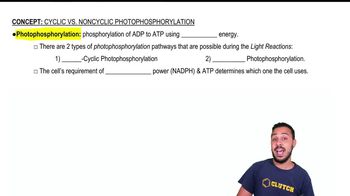
Photophosphorylation
Phosphorylation of ADP to ATP using solar energy during the light reactions, providing energy for cellular processes.
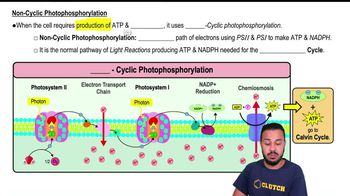
Non-Cyclic Photophosphorylation
Linear electron flow through photosystems II and I, producing both ATP and NADPH for the Calvin cycle.
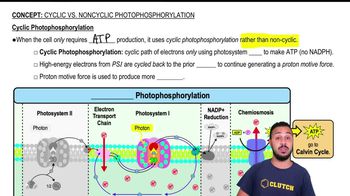
Cyclic Photophosphorylation
Cyclic electron flow through photosystem I, generating only ATP without producing NADPH.
Photosystem II
Protein complex initiating electron flow by extracting electrons from water, starting the linear pathway.
Photosystem I
Protein complex accepting electrons from the electron transport chain, crucial in both cyclic and non-cyclic pathways.
Electron Transport Chain
Series of proteins transferring electrons, building a hydrogen ion gradient to drive ATP synthesis.
ATP
Energy-carrying molecule produced during light reactions, essential for powering the Calvin cycle.
NADPH
Reducing power molecule generated in non-cyclic photophosphorylation, used in carbon fixation.
Calvin Cycle
Metabolic pathway utilizing ATP and NADPH from light reactions to fix carbon into organic molecules.
Hydrogen Ion Gradient
Difference in proton concentration across the thylakoid membrane, driving ATP synthesis.
Proton Motive Force
Potential energy from the hydrogen ion gradient, used to power ATP production.
Reducing Power
Capacity to donate electrons, mainly provided by NADPH for biosynthetic reactions.
Light Reactions
Stage of photosynthesis where solar energy is converted into chemical energy as ATP and NADPH.
 BackBack
 03:57
03:57