Back

Classes of Antibodies quiz

Control buttons has been changed to "navigation" mode.
1/15
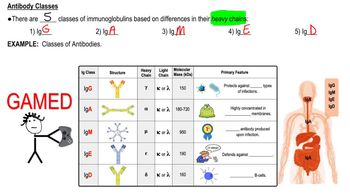
  • What are the five classes of antibodies, and what mnemonic can help you remember them?

    The five classes are IgG, IgA, IgM, IgE, and IgD, remembered by the mnemonic 'GAMED.'
  • Which part of the antibody distinguishes one class from another?

    The heavy chain distinguishes one antibody class from another; the light chain is the same in all classes.
  • Which antibody class is the most abundant in blood and tissues?

    IgG is the most abundant antibody class in blood and tissues, making up about 80% of all antibodies.
  • What unique ability does IgG have that is important for fetal and newborn immunity?

    IgG can cross the placenta, providing immunity to the fetus during pregnancy and to the newborn after birth.
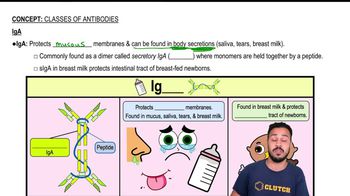
  • What is the main structural form of IgA, and where is it primarily found?

    IgA is commonly found as a dimer called secretory IgA, and it is concentrated in mucus membranes and body secretions like saliva, tears, and breast milk.
  • How does secretory IgA in breast milk benefit newborns?

    Secretory IgA in breast milk helps protect the intestinal tract of breastfed newborns from pathogens.
  • Which antibody class is the first produced during a primary infection?

    IgM is the first antibody produced during a primary infection by plasma cells.
  • What is the structural form of IgM, and how does this relate to its function?

    IgM is a pentamer, giving it 10 antigen binding sites, making it very effective at linking antigens and activating the complement system.
  • Why does IgM primarily remain in the bloodstream?

    IgM is very large due to its pentameric structure, which prevents it from leaving the blood and entering tissues.
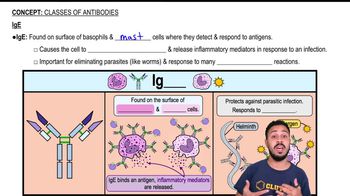
  • Which antibody class is associated with allergic reactions and defense against parasites?

    IgE is associated with allergic reactions and defense against parasitic infections by triggering degranulation of basophils and mast cells.
  • Where are IgE antibodies primarily found, and what cells do they interact with?

    IgE antibodies are found on the surface of basophils and mast cells, where they trigger degranulation upon antigen binding.
  • What is the main function of IgD antibodies?

    IgD is found on the surface of B cells and signals their activation and differentiation into plasma cells.
  • Which antibody class has the longest half-life, and why is this important?

    IgG has the longest half-life, which allows it to provide prolonged protection, especially to newborns after birth.
  • Which antibody class is most effective at activating the complement system?

    IgM is the most efficient antibody class at activating the complement system via the classical pathway.
  • What is the primary role of IgA in the immune system?

    IgA protects mucus membranes and is found in secretions like saliva, tears, and breast milk, defending against pathogens at these surfaces.