Skip to main content
Microbiology
My Course
Learn
Exam Prep
AI Tutor
Study Guides
Textbook Solutions
Flashcards
Explore
Try the app
My Course
Learn
Exam Prep
AI Tutor
Study Guides
Textbook Solutions
Flashcards
Explore
Try the app
Back
Calvin Cycle definitions
You can tap to flip the card.
Calvin Cycle
You can tap to flip the card.
👆
Calvin Cycle
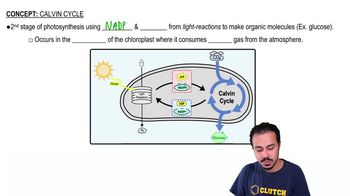
Second stage of photosynthesis in the stroma, using ATP and NADPH to build glucose from CO2.
Track progress
Control buttons has been changed to "navigation" mode.
1/15
Related flashcards
Related practice
Recommended videos
Calvin Cycle quiz
Calvin Cycle
15 Terms
Calvin Cycle
13. Photosynthesis
3 problems
Topic
Brendan
Prokaryotic Photosynthesis
13. Photosynthesis
5 problems
Topic
Brendan
13. Photosynthesis
9 topics
12 problems
Chapter
Brendan
Guided course
03:42
Calvin Cycle
6
views
Guided course
11:14
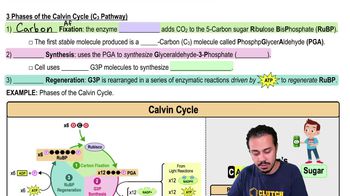
3 Phases of the Calvin Cycle (C3 Pathway)
4
views
Terms in this set (15)
Hide definitions
Calvin Cycle
Second stage of photosynthesis in the stroma, using ATP and NADPH to build glucose from CO2.
Stroma
Fluid-filled space inside the chloroplast where the Calvin Cycle takes place, distinct from thylakoids.
Chloroplast
Organelle in plant cells housing both light reactions and the Calvin Cycle for photosynthesis.
ATP
Energy-carrying molecule produced in light reactions, consumed during the Calvin Cycle to drive reactions.
NADPH
Electron carrier generated in light reactions, providing reducing power for carbon fixation in the Calvin Cycle.
Carbon Fixation
First phase where CO2 is attached to RuBP by rubisco, forming a stable 3-carbon compound.
RuBisCO
Enzyme catalyzing the attachment of atmospheric CO2 to RuBP, initiating the Calvin Cycle.
Ribulose Bisphosphate (RuBP)
Five-carbon sugar acting as the CO2 acceptor in the Calvin Cycle, regenerated each cycle.
Phosphoglyceraldehyde (PGA)
First stable 3-carbon molecule formed after CO2 fixation, precursor to G3P.
Glyceraldehyde 3-phosphate (G3P)
Three-carbon sugar produced from PGA, serving as a direct precursor for glucose synthesis.
Glucose
Six-carbon sugar produced as the main output of the Calvin Cycle, storing chemical energy.
C3 Pathway
Photosynthetic route where the first stable product is a 3-carbon molecule, typical of most plants.
RuBP Regeneration
Final phase where leftover G3P is rearranged, using ATP, to reform the CO2 acceptor molecule.
Light Reactions
Photosynthetic stage producing ATP and NADPH, which fuel the Calvin Cycle.
CO2
Atmospheric gas serving as the carbon source for sugar synthesis in the Calvin Cycle.
 BackBack
 03:42
03:42