Back

Archaeal Cell Membranes quiz

Control buttons has been changed to "navigation" mode.
1/15
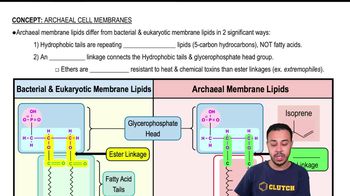
  • What are the two main differences between archaeal membrane lipids and those of bacteria and eukaryotes?

    Archaeal membrane lipids have hydrophobic tails made of isoprene units and use ether linkages instead of ester linkages.
  • What is isoprene, and how does it relate to archaeal membrane lipids?

    Isoprene is a 5-carbon hydrocarbon, and archaeal membrane lipids have hydrophobic tails made of repeating isoprene units.
  • Do archaeal membrane lipids contain fatty acids in their hydrophobic tails?

    No, archaeal membrane lipids do not contain fatty acids; they have isoprene chains instead.
  • What type of linkage connects the hydrophobic tails to the head group in archaeal membrane lipids?

    An ether linkage connects the hydrophobic tails to the glycerophosphate head group in archaeal membrane lipids.
  • Why are ether linkages in archaeal membranes significant?

    Ether linkages are more resistant to heat and chemical toxins, helping archaea survive extreme conditions.
  • What is the main structural difference between bacterial/eukaryotic and archaeal membrane lipids?

    Bacterial and eukaryotic membrane lipids have fatty acid tails and ester linkages, while archaeal lipids have isoprene tails and ether linkages.
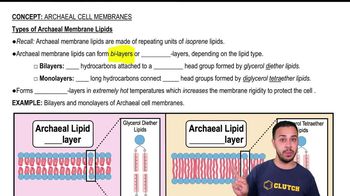
  • What are the two types of layers that archaeal membranes can form?

    Archaeal membranes can form either bilayers or monolayers, depending on the type of lipid present.
  • Which type of archaeal lipid forms bilayers, and what is its structure?

    Glycerol diether lipids form bilayers, consisting of two isoprene chains attached to a single glycerophosphate head group.
  • What does the 'di' in glycerol diether lipid refer to?

    'Di' refers to the presence of two ether linkages in the molecule.
  • Which type of archaeal lipid forms monolayers, and what is its structure?

    Diglycerol tetraether lipids form monolayers, with two long isoprene chains connected to two glycerophosphate head groups.
  • What does the 'tetra' in diglycerol tetraether lipid refer to?

    'Tetra' refers to the presence of four ether linkages in the molecule.
  • How does the structure of a monolayer differ from a bilayer in archaeal membranes?

    A monolayer is formed by a single molecule with two head groups and four ether linkages, while a bilayer consists of two separate molecules each with one head group and two ether linkages.
  • Why are monolayers important for some archaea?

    Monolayers increase membrane rigidity, which is crucial for survival in extremely hot temperatures.
  • How do archaeal membrane adaptations help extremophiles?

    The use of ether linkages and the ability to form monolayers make archaeal membranes more resistant to heat and chemicals, aiding survival in extreme environments.
  • What is the functional advantage of ether linkages over ester linkages in archaeal membranes?

    Ether linkages provide greater chemical and thermal stability, making archaeal membranes more robust in harsh conditions.