Back

Antiviral Drugs quiz

Control buttons has been changed to "navigation" mode.
1/15
  • What is the main challenge in developing antiviral drugs compared to antibiotics?

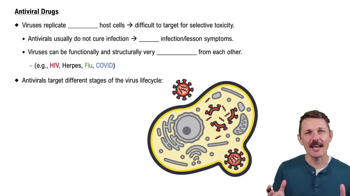
    Viruses replicate inside host cells and use host cellular machinery, making selective toxicity harder to achieve.
  • Do most antiviral drugs cure viral infections?

    No, most antivirals reduce symptoms and viral load but do not cure infections; the body must clear the virus itself.
  • What is the exception to the rule that antivirals do not cure infections?

    Hepatitis C can now be completely cured with certain antiviral drugs.
  • What are the three main types of viruses mentioned in the lesson?

    Retroviruses (like HIV), DNA viruses (like herpes), and RNA viruses (like flu and COVID-19).
  • What is the function of entry inhibitors in antiviral therapy?

    Entry inhibitors block viruses from attaching to and entering host cells by targeting cell receptors.
  • How does the drug Maraviroc work against HIV?

    Maraviroc binds to a receptor on immune cells that HIV uses to recognize and infect the cell, preventing entry.
  • What are nucleic acid analogs and how do they inhibit viral replication?

    Nucleic acid analogs mimic normal DNA or RNA building blocks but disrupt viral polymerases, stopping replication.
  • Why can drugs like acyclovir selectively target herpes viruses?

    Herpes viruses have their own viral DNA polymerase, which acyclovir targets without affecting host enzymes.
  • What enzyme does tenofovir target in HIV, and why is this effective?

    Tenofovir targets reverse transcriptase, an enzyme unique to retroviruses like HIV that converts RNA into DNA.
  • Which enzyme does remdesivir inhibit in COVID-19, and why is this selective?

    Remdesivir inhibits RNA-dependent RNA polymerase, an enzyme used by RNA viruses but not found in human cells.
  • What is the role of protease inhibitors in antiviral therapy?

    Protease inhibitors prevent the cleavage of viral protein precursors, resulting in nonfunctional viral proteins.
  • Name two protease inhibitors and the viruses they target.

    Ritonavir (used for COVID-19) and saquinavir (used for HIV) are protease inhibitors.
  • How do neuraminidase inhibitors like oseltamivir (Tamiflu) work against the flu?

    They block the neuraminidase enzyme, trapping new flu virus particles inside the host cell and slowing infection spread.
  • What is the function of interferons in antiviral therapy?

    Interferons stimulate the immune system to produce antiviral proteins and enhance the body's antiviral response.
  • Why is it difficult to develop broad-spectrum antiviral drugs?

    Viruses are functionally and structurally diverse, making it hard to find drugs that work against many types.