Back

Animal Viruses: RNA Virus Synthesis & Replication definitions

Control buttons has been changed to "navigation" mode.
1/15
  • Replicase

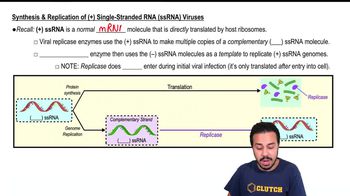
    An RNA-dependent RNA polymerase essential for synthesizing new RNA molecules from an RNA template in RNA viruses.
  • Plus Single-Stranded RNA

    A viral genome identical to mRNA, allowing direct translation by host ribosomes to produce viral proteins.
  • Minus Single-Stranded RNA

    A viral genome complementary to mRNA, requiring conversion to a plus strand before translation can occur.
  • Double-Stranded RNA

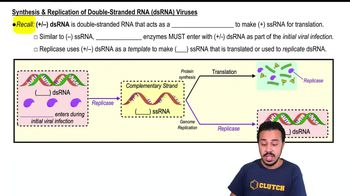
    A viral genome containing both coding and non-coding strands, serving as a template for plus strand synthesis.
  • RNA-Dependent RNA Polymerase

    An enzyme that synthesizes RNA from an RNA template, crucial for RNA virus genome replication.
  • Messenger RNA

    A single-stranded RNA molecule that can be directly translated by host ribosomes to produce proteins.
  • Viral Genome

    The complete RNA genetic material of a virus, serving as the blueprint for replication and protein synthesis.
  • Translation

    The process where ribosomes synthesize proteins using mRNA as a template, producing viral components.
  • Viral Proteins

    Molecules produced from viral mRNA that are necessary for virus structure, replication, and infection.
  • Host Cell

    A living cell that provides the environment and machinery for viral replication and protein synthesis.
  • Initial Viral Infection

    The entry phase when a virus introduces its genome and essential enzymes into a host cell.
  • Viral Particle

    A complete virus structure, including genome and proteins, capable of infecting new host cells.
  • Cytoplasm

    The cellular compartment where most RNA virus replication and protein synthesis occur.
  • Template Strand

    An RNA sequence used by replicase to synthesize a complementary RNA molecule during replication.
  • Assembly

    The process of combining viral genomes and proteins to form new infectious viral particles.