Back

Animal Viruses: Reverse-Transcribing Virus Synthesis & Replication quiz

Control buttons has been changed to "navigation" mode.
1/15
  • What enzyme do reverse transcribing viruses encode that is essential for their replication?

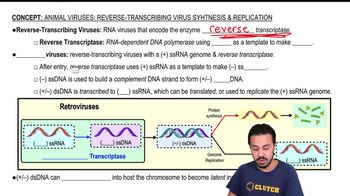
    They encode the enzyme reverse transcriptase.
  • What is the function of reverse transcriptase in reverse transcribing viruses?

    Reverse transcriptase uses RNA as a template to synthesize DNA.
  • What type of genome do retroviruses possess?

    Retroviruses have a plus single-stranded RNA (ssRNA) genome.
  • What two components do retroviruses inject into host cells upon entry?

    They inject their plus ssRNA genome and the enzyme reverse transcriptase.
  • What does reverse transcriptase synthesize from the plus ssRNA genome?

    It synthesizes minus single-stranded DNA (ssDNA) from the plus ssRNA genome.
  • How is double-stranded DNA (dsDNA) formed in the replication cycle of retroviruses?

    The minus ssDNA is used to create a complementary DNA strand, forming dsDNA.
  • What can the double-stranded DNA (dsDNA) produced by reverse transcriptase be used for?

    It can be transcribed to produce more plus ssRNA for protein synthesis or genome replication.
  • What is the significance of the plus ssRNA produced from dsDNA in retroviruses?

    It serves as messenger RNA for protein synthesis or as the genome for new viruses.
  • What unique ability does the dsDNA of retroviruses have regarding the host cell's genome?

    The dsDNA can integrate into the host cell's chromosome.
  • What is the result of the viral dsDNA integrating into the host cell's chromosome?

    The virus can become latent and replicate along with the host cell.
  • Why is reverse transcriptase called an RNA-dependent DNA polymerase?

    Because it uses RNA as a template to synthesize DNA.
  • What happens to the original plus ssRNA genome during retrovirus replication?

    It is regenerated at the end of genome replication.
  • What does it mean for a virus to be latent in a host cell?

    It means the viral genome is integrated and dormant, replicating with the host cell without producing new viruses immediately.
  • What is the reverse of transcription, and which enzyme performs this process in retroviruses?

    Reverse transcription is the synthesis of DNA from an RNA template, performed by reverse transcriptase.
  • How does the integration of viral DNA into the host genome benefit the virus?

    It allows the virus to remain silent and persist in the host, replicating whenever the host cell divides.