Back

Animal Viruses: Antigenic Drift vs. Antigenic Shift quiz

Control buttons has been changed to "navigation" mode.
1/15
  • What is the enzyme replicase used by RNA viruses, and what is its key limitation?

    Replicase is an RNA-dependent RNA polymerase used by RNA viruses, and it lacks proofreading ability, leading to mutations.
  • How does the lack of proofreading in replicase contribute to viral evolution?

    Without proofreading, replicase allows mutations to accumulate over time, resulting in genetic variation in viruses.
  • What is antigenic drift?

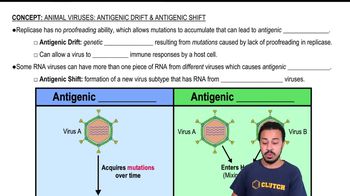
    Antigenic drift is the gradual accumulation of genetic mutations in a virus, causing changes in its observable traits.
  • How does antigenic drift help viruses evade the host immune system?

    Antigenic drift creates new viral strains with altered antigens, making it harder for the immune system to recognize and respond.
  • Why is the flu vaccine updated every year?

    The influenza virus undergoes antigenic drift, resulting in new strains that require updated vaccines for effective protection.
  • What type of virus is the influenza virus?

    The influenza virus is an RNA virus.
  • What is antigenic shift?

    Antigenic shift occurs when two RNA viruses infect the same cell and mix their RNA, creating a new virus subtype.
  • How does antigenic shift differ from antigenic drift?

    Antigenic shift involves the mixing of RNA from different viruses to form a new subtype, while antigenic drift is caused by gradual mutations.
  • What is required for antigenic shift to occur?

    Antigenic shift requires two RNA viruses to infect the same cell simultaneously, allowing their RNA to mix.
  • What is the result of antigenic shift in terms of viral genetics?

    Antigenic shift produces a new virus with RNA segments from both parent viruses.
  • How do antigenic drift and shift impact vaccine development?

    Both processes create new viral strains or subtypes, making it necessary to update vaccines regularly.
  • What observable effect can mutations from antigenic drift have on viruses?

    Mutations can change the virus's phenotypic traits, such as its surface proteins.
  • Why can viruses with antigenic drift reproduce more effectively?

    They can evade host immune responses, allowing them to infect hosts more successfully.
  • What happens when virus A and virus B infect the same cell at the same time?

    Their RNA can mix, resulting in a new virus (virus C) with genetic material from both.
  • How do antigenic drift and shift contribute to viral adaptability?

    They enable viruses to change genetically, helping them survive and spread despite immune defenses and vaccines.