Back

Animal Viruses: 5. Release from Host Cell quiz

Control buttons has been changed to "navigation" mode.
1/15
  • What is the main process by which enveloped animal viruses are released from the host cell?

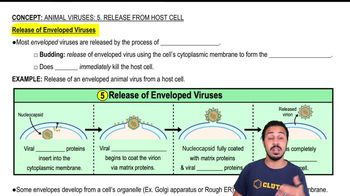
    Enveloped animal viruses are mainly released by a process called budding, which uses the host cell's cytoplasmic membrane to form the viral envelope.
  • Does budding immediately kill the host cell during the release of enveloped viruses?

    No, budding does not immediately kill the host cell, allowing the cell to continue functioning after viral release.
  • What role do viral spike proteins play during the release of enveloped viruses?

    Viral spike proteins insert into the host cell's cytoplasmic membrane, becoming part of the viral envelope as the virus buds out.
  • How do matrix proteins contribute to the formation of the viral envelope in enveloped viruses?

    Matrix proteins coat the nucleocapsid and link it to the forming viral envelope during the budding process.
  • From which cellular structures can enveloped viruses acquire their lipid envelope besides the cytoplasmic membrane?

    Enveloped viruses can also acquire their lipid envelope from organelles such as the Golgi apparatus or the rough endoplasmic reticulum.
  • What is the fate of the host cell after the release of non-enveloped viruses?

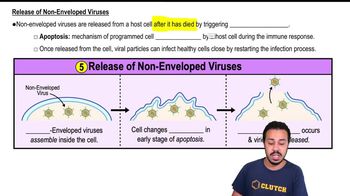
    The host cell undergoes apoptosis, a programmed cell death process, which leads to the release of non-enveloped viral particles.
  • What is apoptosis and how is it related to non-enveloped virus release?

    Apoptosis is a programmed cell death mechanism, often initiated by the immune response, that allows non-enveloped viruses to be released as the cell dies.
  • How do non-enveloped viruses escape from the host cell?

    Non-enveloped viruses escape when the host cell changes shape and breaks apart during apoptosis, releasing the viral particles.
  • What happens to viral particles after they are released from the host cell?

    After release, viral particles can infect neighboring healthy cells, restarting the infection cycle.
  • What is the main structural difference between enveloped and non-enveloped viruses regarding their release?

    Enveloped viruses acquire a lipid envelope during release, while non-enveloped viruses do not and are released after cell death.
  • What is the function of the viral envelope in enveloped viruses?

    The viral envelope surrounds the nucleocapsid and contains spike proteins that help the virus infect new cells.
  • How does the release process of enveloped viruses differ from that of non-enveloped viruses?

    Enveloped viruses are released by budding, preserving the host cell, while non-enveloped viruses are released after the host cell dies via apoptosis.
  • What cellular changes occur during apoptosis that facilitate the release of non-enveloped viruses?

    During apoptosis, the host cell changes shape and eventually breaks apart, allowing non-enveloped viruses to escape.
  • Can enveloped viruses always use the cytoplasmic membrane for envelope formation?

    No, some enveloped viruses can use membranes from organelles like the Golgi apparatus or rough ER to form their envelope.
  • What is the significance of the matrix protein in the assembly of enveloped viruses?

    The matrix protein links the nucleocapsid to the viral envelope, ensuring proper assembly and release of the mature virion.