Back

Acute vs. Persistent Viral Infections quiz

Control buttons has been changed to "navigation" mode.
1/15
  • What are the two main categories of animal virus infections?

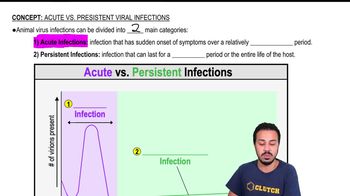
    The two main categories are acute infections and persistent infections.
  • How are acute viral infections characterized in terms of symptom onset and duration?

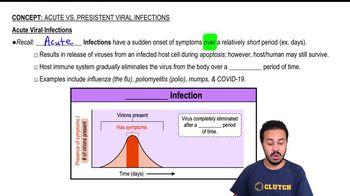
    Acute infections have a sudden onset of symptoms that last for a short period of time, usually just a few days.
  • What is the main feature of persistent viral infections?

    Persistent infections last for very long periods, sometimes for the entire lifespan of the host.
  • How does the host's immune system typically handle acute viral infections?

    The immune system gradually eliminates the virus from the body within a short period of time.
  • Name two examples of acute viral infections.

    Examples include influenza (the flu) and COVID-19.
  • What happens to host cells during an acute viral infection?

    Some host cells die during acute infection due to virus release during apoptosis, but the host usually survives.
  • How are persistent infections further categorized?

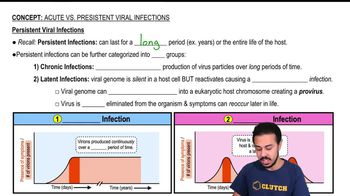
    Persistent infections are divided into chronic infections and latent infections.
  • What distinguishes chronic infections from latent infections?

    Chronic infections continuously produce viral particles, while latent infections do not produce viral particles continuously and can remain dormant.
  • What is a provirus in the context of latent infections?

    A provirus is the viral genome integrated into the host cell's chromosome, remaining dormant until reactivated.
  • How do symptoms and viral particle production differ in chronic infections over time?

    Symptoms may occur initially and then disappear, but viral particles continue to be produced for years.
  • What happens during the dormant phase of a latent infection?

    The viral genome integrates into the host chromosome and does not produce viral particles during this time.
  • How can a latent infection become active again?

    The virus can reactivate after several years, leading to the production of new viral particles and possible symptoms.
  • Are viruses eliminated from the host in persistent infections?

    No, viruses are not eliminated in persistent infections, unlike in acute infections.
  • What does a graph of an acute infection typically show regarding time and viral particles?

    It shows a rapid increase and then elimination of viral particles within a few days.
  • What does a graph of a chronic infection typically show regarding viral particle production?

    It shows continuous production of viral particles over a long period, often years.