Back

Activation of T Lymphocytes definitions

Control buttons has been changed to "navigation" mode.
1/14
  • Dendritic Cell

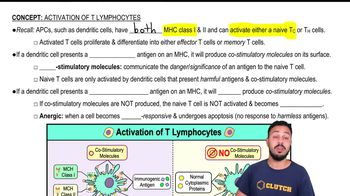
    An antigen-presenting cell with both MHC Class I and II, capable of activating naive cytotoxic and helper T cells.
  • MHC Class I

    A molecule on antigen-presenting cells that displays antigens to naive cytotoxic T cells, initiating their activation.
  • MHC Class II

    A molecule on antigen-presenting cells that presents antigens to naive helper T cells, leading to their activation.
  • Naive T Cell

    An immune cell that has not yet encountered its specific antigen and requires activation to initiate a response.
  • Cytotoxic T Cell

    A T lymphocyte subtype that, once activated, targets and eliminates cells displaying harmful antigens.
  • Helper T Cell

    A T lymphocyte subtype that, upon activation, coordinates immune responses by signaling other immune cells.
  • Co-stimulatory Molecule

    A surface molecule produced by dendritic cells presenting harmful antigens, essential for full T cell activation.
  • Effector T Cell

    A differentiated T cell clone that actively participates in eliminating harmful antigens during an immune response.
  • Memory T Cell

    A long-lived T cell clone that persists after activation, enabling rapid response upon re-exposure to the same antigen.
  • Anergy

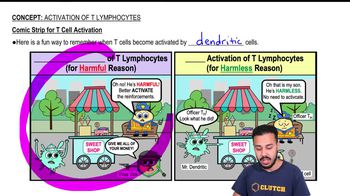
    A state of unresponsiveness in T cells resulting from antigen presentation without co-stimulatory signals.
  • Apoptosis

    A programmed cell death process that eliminates anergic T cells, preventing responses to harmless antigens.
  • Antigen

    A molecule recognized by the immune system, which can be harmful or harmless, and is presented by dendritic cells.
  • Immunogenic Antigen

    A harmful molecule that triggers dendritic cells to produce co-stimulatory molecules and activate T cells.
  • Antigen-Presenting Cell

    A cell type, such as a dendritic cell, that displays antigens on MHC molecules to initiate T cell responses.